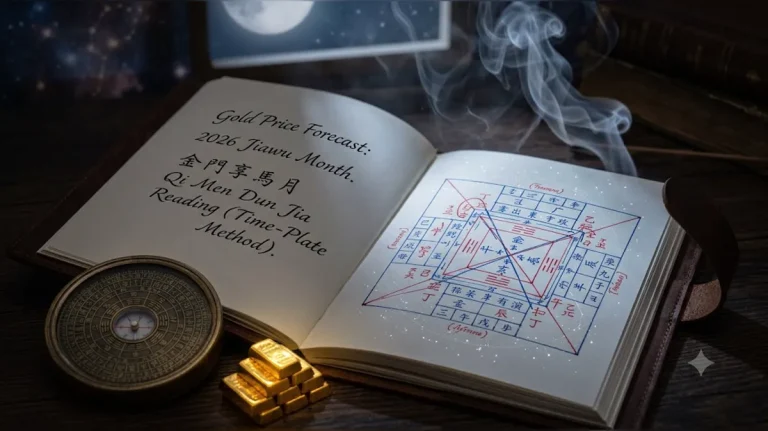

Qi Men Dun Jia · Strategic Situation Reading
A practical method for moving from a verified Nine-Palace board to stakeholder position, sequence, timing, and one testable next action.
# How to Read a Qi Men Dun Jia Chart: A 7-Step Guide
Qi Men Dun Jia is most useful when a decision involves several moving parts: people with different interests, limited resources, competing routes, an order of operations, or a meaningful time window. A chart is not a bag of lucky symbols. It is a time-specific map of relationships that should lead to a testable action.
This guide uses OracleEast’s declared method: Shi Jia rotating-plate Qi Men Dun Jia with the Chai Bu method (时家转盘拆补法), the center palace hosted in Kun, and the celestial arrangement of the Eight Deities. Other schools use different rules, so method disclosure is part of accuracy.
The reading path at a glance
What a Qi Men Dun Jia chart is—and is not
A time-based Qi Men chart arranges the Nine Palaces with the Three Wonders and Six Instruments, Nine Stars, Eight Doors, and Eight Deities for a casting moment. In strategic use, these layers describe position, access, capability, friction, support, and timing. Meaning comes from the relationships among the decision-maker, matter, parties, resources, and options.
The chart does not replace due diligence. It can organize questions about leverage, initiative, sequence, exposure, and the next review point; it cannot repair a bad contract or create missing cash flow.
OracleEast’s free Qi Men Dun Jia chart displays the verifiable board without an automatic verdict. Computation and contextual judgment remain distinct.
Before interpretation: declare the casting method
“Qi Men Dun Jia” names a family of practices, not one universal software setting. This guide uses:
- hour-based Shi Jia casting, rotating plate, and Chai Bu Ju selection;
- exact solar-term transitions;
- the center palace hosted in Kun and the celestial Eight Deities;
- local civil time with an IANA time zone, optional true solar time, and a midnight date boundary.
The Hong Kong Observatory explains that the 24 solar terms divide the ecliptic into 15-degree segments; an exact transition can occur at a particular minute. IANA time-zone rules also capture historical UTC offsets and daylight-saving changes. Near either boundary, shortcuts can cast the wrong board.
These details may look technical, but they prevent a quiet failure: a polished chart built from the wrong time, Dun, or Ju.
The seven-step reading workflow
Step 1: Define one strategic situation and the decision horizon
Start with one situation, not an autobiography. A good Qi Men question can still contain several parties or options, but they must belong to the same decision system.
Weak: “What will happen to my business, relationship, health, and finances?”
Better: “Over the next six weeks, should we enter the new market through a distributor, a local partner, or a direct pilot—and what sequence reduces our exposure?”
Name the decision-maker, alternatives, constraints, horizon, and what “better” means—faster learning, lower downside, stronger bargaining position, or another measurable criterion. This gives the chart a stable target.
If the issue is one immediate matter with one near-term result or one choice, the Jin Kou Jue one-question method may be the cleaner framework. Our Qi Men Dun Jia versus Da Liu Ren guide explains that routing boundary without calling either method “simple” or “complex.”
Step 2: Verify the board before reading it
Write down the casting time, location, IANA time zone, whether true solar time is used, current solar term, upper/middle/lower Yuan, Yin or Yang Dun, Ju number, day and hour pillars, Xun leader, Chief Star, and Chief Door. If the question was cast close to midnight, a daylight-saving transition, or a solar-term boundary, check it twice.
Four quick validations catch many software errors:
- Does the displayed local time match the time the question was fixed?
- Does the time zone reflect daylight-saving rules for that location and date?
- Does the solar term change at the exact transition, not at midnight on an estimated date?
- Do the Chief Star and Chief Door follow the displayed Xun leader and hour position under the declared method?
Do not interpret a board that fails these checks. A confident reading cannot rescue an incorrect cast.
Step 3: Identify the decision-maker, matter, and designated symbols
For a general strategic reading, OracleEast begins with the day stem as the decision-maker and the hour stem as the matter or current action. Add topic-specific symbols only when needed: a Door may describe access, a stem a counterparty, and a direction or palace an option. Label every convention used.
Write the assignments before evaluating “good” and “bad.” If Option A is East and Option B is West, lock that mapping before comparing the palaces. Otherwise the reader can unconsciously move the preferred option to the stronger palace.
Birth information is not required to compute a time chart. If a birth-year stem is added as a secondary reference, label it separately.
Step 4: Read each relevant palace as one integrated stack
Every relevant palace is a system. Avoid interpreting a Door, Star, or Deity in isolation.
Use this order:
| Layer | Reading question |
|---|---|
| Palace and season | Is the palace supported, and what element enters the relationship? |
| Earth and heaven stems | What is underlying, what is arriving, and what configuration forms? |
| Door | What kind of access, behavior, or process is available? |
| Star | What capability, pace, or operating quality shapes the situation? |
| Deity | Does the manner suggest visibility, concealment, coordination, or pressure? |
| Markers | Is the palace empty, moving, in Fu Yin or Fan Yin, or otherwise time-conditioned? |
The same symbol can work differently in different stacks. An Open Door in a depleted or empty palace is not automatically a green light. A difficult Door in a strong, well-supported palace may describe a necessary constraint rather than failure. Interpretation starts with composition and relationship, not with a lucky-symbol checklist.
Step 5: Compare relationships, initiative, and usable leverage
Now compare the decision-maker’s palace with the matter and option palaces. Look at generating and controlling relationships, same-palace alignment, opposition, combinations, and the direction of influence.
Ask concrete questions:
- Does the matter support the decision-maker, drain them, control them, or depend on them?
- Which party holds initiative, and which is reacting?
- Is the attractive option accessible now, or only visible but unsupported?
- Does a resource sit with the decision-maker, the counterparty, or outside both?
- Is the strongest palace relevant to the objective, or merely strong in an unrelated way?
Strength is not the same as suitability. A forceful configuration can be useful for enforcement and harmful for diplomacy. A quiet configuration can be weak for a public launch and excellent for research, negotiation preparation, or a limited pilot. Always judge relative to the stated success criterion from Step 1.
Step 6: Turn the board into sequence and timing
Qi Men is especially valuable when the question is not only “yes or no,” but “what first, through whom, and when?” Translate the chart into an operational sequence.
For example:
- verify the hidden dependency before announcing;
- approach the supportive party before the formal decision-maker;
- run a small pilot before committing full resources;
- negotiate the control term before discussing price;
- wait for a specific condition, then act within a defined review window.
Timing should be expressed as a testable window or trigger, not mystical precision. “Within the next seven days, after written confirmation of inventory, run the pilot” is useful. “Success will arrive at an auspicious time” is not. Empty palaces and the Horse Star may modify availability or movement, but they do not justify inventing a date without a consistent timing rule.
Step 7: Write a decision memo with a stop condition
Finish with a short memo that can survive contact with reality:
- Current position: one sentence describing the decision-maker’s leverage.
- Best route: the preferred option and why it fits the chart and business facts.
- Order of action: no more than three steps.
- Timing window: a date range or observable trigger.
- Primary risk: the one condition most likely to reverse the recommendation.
- Stop condition: the evidence that means “do not proceed” or “recast because the situation materially changed.”
This last item matters. A chart belongs to a moment and a defined situation. If the counterparty changes, financing disappears, or the legal structure is rewritten, you no longer have the same decision system. Do not keep stretching the old chart to cover a new problem.
A worked comparison: distributor, partner, or direct pilot
Imagine a founder considering three routes into a market. A weak reading says, “The Open Door is auspicious; launch now.” A disciplined reading compares positions.
The founder’s day-stem palace represents capacity; the hour-stem palace represents the market-entry matter. Distributor, partner, and pilot are assigned before interpretation, then compared for access, control, resources, and timing.
Suppose the pilot has modest scale but a coherent stack, the distributor is visible but empty, and the partner controls a critical resource. A possible memo is: pilot to produce demand evidence; approach the partner with that evidence; reserve the distributor for later scale; stop if repeat demand is not confirmed within the window.
The value lies in sequence. The chart did not replace market research. It organized the order in which uncertainty should be reduced.
To follow the reading sequence on a chart you generate yourself, use the free Qi Men chart tool. Check the question, time and place before comparing the indicators; a diagram alone is not evidence of a verified outcome.
Common mistakes when reading a Qi Men chart
Reading one “good” symbol as the whole verdict
An auspicious Door or Deity cannot be detached from palace strength, stems, season, emptiness, and the question.
Changing symbol assignments after seeing the board
This turns interpretation into preference confirmation. Lock the decision-maker, matter, parties, options, and success criteria first.
Treating strength as universally favorable
The strongest party may be the competitor. The useful route is the one that serves the stated objective at an acceptable cost.
Asking several unrelated questions with one chart
Multiple parties in one strategic situation are appropriate. Unrelated questions about career, romance, health, and property are not. Use BaZi and Zi Wei for the longer life path, and a fresh, clearly bounded decision framework for a new matter.
Outsourcing judgment to a long automatic interpretation
More words do not mean more accuracy. A useful free tool should make the computed board inspectable. A paid interpretation should be analyzed, written, and reviewed by a practitioner—not presented as an AI-generated report.
What the free chart can and cannot tell you
The OracleEast calculator verifies the computational layer: casting time, time zone, solar term, Dun and Ju, earth plate, Xun leader, Chief Star and Door, rotating layers, emptiness, and Horse Star. The question stays in the browser and is not uploaded or stored.
It cannot know who signs the contract, which constraint is non-negotiable, or what success means unless those facts are mapped. OracleEast’s paid decision work is manually analyzed, written, and reviewed—not automatically generated by AI.
If you want to inspect the board first, open the free Qi Men Dun Jia strategic chart. If you want the broader commercial rationale, read how Qi Men functions as a strategic decision system. For a practitioner-reviewed decision memo, see Strategic Decision Timing.
Frequently asked questions
Does Qi Men Dun Jia require my birth date?
Not to compute a time-based chart. Some readers add a birth-year stem as a secondary personal reference, but the casting itself depends on the chosen moment, method, and time rules. Any optional birth data should be clearly separated from the calculation.
Should I use civil time or true solar time?
Use a declared, consistent rule. OracleEast defaults to local civil time with an IANA time zone and offers true solar time as an explicit option. Do not silently switch after seeing the result.
Can one chart compare several options?
Yes, when the options belong to the same strategic situation and are assigned before interpretation. Qi Men is particularly suited to comparing parties, routes, resources, sequence, and timing within one decision field.
When should I cast a new chart?
Cast again when a genuinely new question arises or the decision system materially changes—such as a new counterparty, a rewritten agreement, or a different resource constraint. Do not recast repeatedly to shop for a preferred answer.
Is this scientific evidence that Qi Men predicts outcomes?
No. The historical sources document a traditional Chinese divination and strategy system; astronomical and time-zone sources support the calendar computation. They do not establish predictive efficacy. Use the method as a structured interpretive framework alongside factual due diligence.
About the author and method
Joy Hu is OracleEast’s lead practitioner and reviewer, with about two decades of study and practice in Chinese metaphysics. This guide was checked against OracleEast’s declared time-based rotating-plate Chai Bu rules, classical source material, and the live calculator’s computational boundary.
Sources and method note
This article uses OracleEast’s declared Shi Jia rotating-plate, Chai Bu implementation. Historical orientation: the Chinese Text Project’s digitized Qi Men Dun Jia Tong Zong and related texts, with scanned images checked when exact characters matter. Calendar computation: the Hong Kong Observatory’s explanation of the 24 solar terms. Civil-time handling: the IANA Time Zone Database. Bibliographic records establish editions and transmission; they do not validate predictive claims.
Author: OracleEast Research Team
Editorial standard: Traditional method terminology, computational checks, and internal consistency reviewed for this guide.
Disclaimer: This educational framework is not legal, medical, investment, or other licensed professional advice.
Inspect the chart, then decide what deserves human judgment
The free tool shows the verifiable board. OracleEast practitioner services turn that structure into a manually analyzed, written, and reviewed decision memo—not an AI-generated report.