
Will I Get the Job? Reading a Jin Kou Jue Chart Beyond Encouraging Messages
Audit a Jin Kou Jue job-seeking case: four positions, monthly-general conventions, timing and the difference between contact and an offer.

Audit a Jin Kou Jue job-seeking case: four positions, monthly-general conventions, timing and the difference between contact and an offer.

A complete Qi Men board shows why an auspicious Open Door does not guarantee success when void and tomb conditions matter.

An empty Life Palace is not an empty destiny. Follow a complete Zi Wei chart through Life, Travel, Wealth and Career.

Understand Hua Ji in the Spouse Palace through a complete Zi Wei chart, the transforming star, related palaces and timing layers.
See what changes across two neighboring birth hours, what stays stable and how responsible BaZi birth-time rectification works.
Compare two complete BaZi charts to understand why Wealth stars, earning capacity and money retained are different questions.
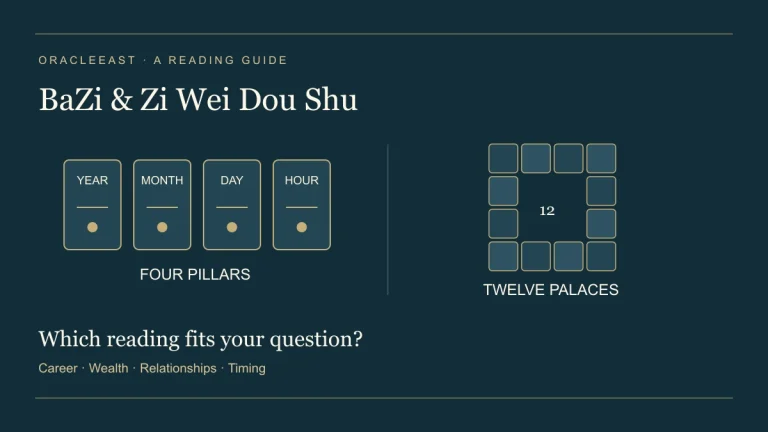
Compare BaZi and Zi Wei Dou Shu across career, wealth, relationships, timing and birth-time accuracy, and learn how to choose the right reading.

Learn how to ask a Jin Kou Jue question with one subject, one event, one time window and one testable result before casting an accurate Four-Position chart.

A practical seven-step framework for reading a Shi Jia rotating-plate, Chai Bu Qi Men Dun Jia chart without reducing the board to lucky symbols.
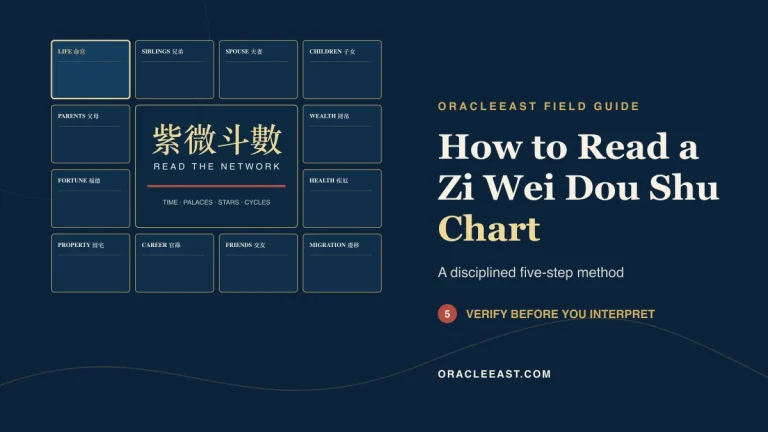
Learn how to read a Zi Wei Dou Shu chart in five disciplined steps—from time correction and 12 palaces to San Fang Si Zheng, major stars, and cycles—correctly.