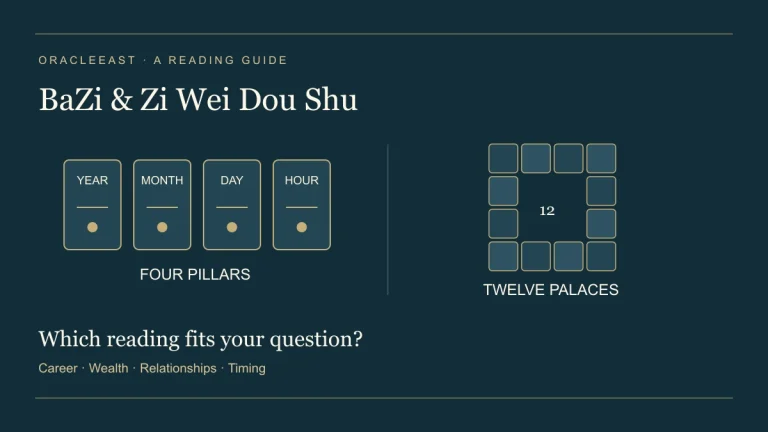
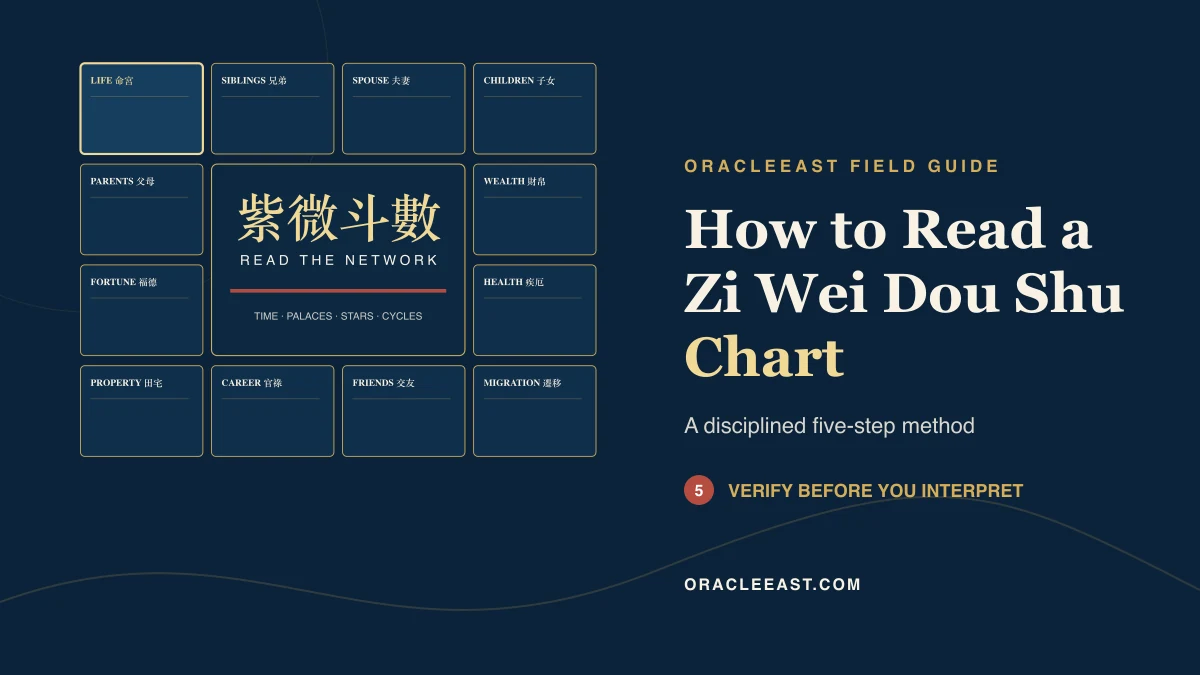

How to read a Zi Wei Dou Shu chart becomes much easier once you stop treating the twelve boxes as twelve separate predictions. Start by verifying the birth time, find the Life Palace, read its San Fang Si Zheng network, add the major stars and Four Transformations, and only then add the decade and annual timing layers.
If you do not yet have a chart, use the free Zi Wei Dou Shu chart calculator. It applies historical time-zone data and a local true-solar-time correction before assigning the two-hour birth branch. An email is required to generate the free chart. OracleEast saves your email and birth details for this requested chart service; this does not subscribe you to marketing emails.
Method boundary. This tutorial follows the Ni Hai-Xia Tian Ji framework used by OracleEast. It does not silently mix in Zi Yun or Zhongzhou self-transformation rules. Other schools may use different leap-month, late-Zi-hour, brightness or transformation conventions.
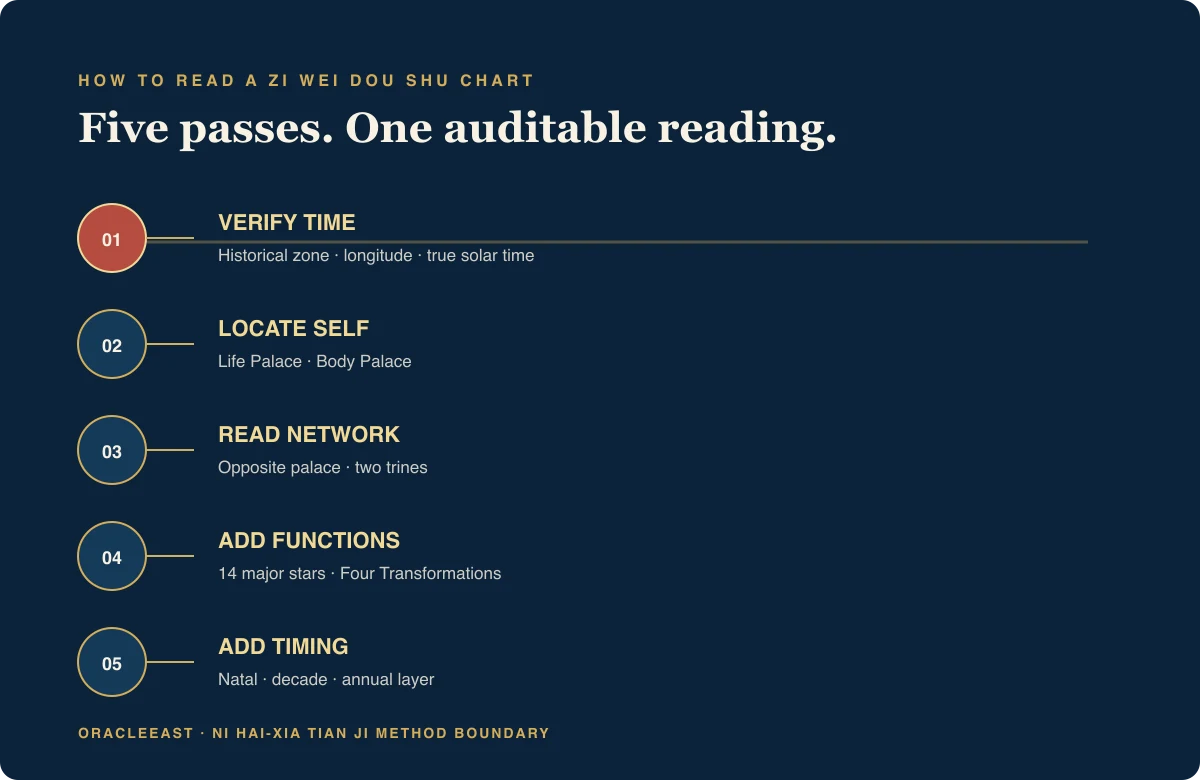
TL;DR: the five-step reading order
- Verify the chart before interpreting it. A different two-hour branch can move the Life Palace and star layout.
- Begin with the Life Palace, but never stop there. Its opposite and two trine palaces form the core San Fang Si Zheng network.
- Read stars as functions inside a palace. A star name is not a verdict, and an “empty” palace is not meaningless.
- Use Four Transformations as modifiers. Hua Lu, Hua Quan, Hua Ke and Hua Ji describe emphasis—not four universal promises.
- Add time last. The natal chart is the structure; decade and annual layers show when part of that structure becomes active.
What is a Zi Wei Dou Shu chart?
A Zi Wei Dou Shu chart is a symbolic map that places major and supporting stars across twelve life palaces according to a person’s birth date, time, sex and charting convention. In English it is often called Purple Star Astrology, although the original Chinese name, 紫微斗數, is more precise.
The twelve palaces organize questions about identity, siblings and peers, partnership, children and creative output, wealth, health, movement, networks, career, property, inner wellbeing and parents or authority. The stars describe operating tendencies within those domains. The chart’s trines, oppositions and timing layers show how the domains qualify one another.
That is why a Zi Wei chart is not a Chinese zodiac profile. Two people born in the same year can have different Life Palaces, star groupings and timing structures because the month, day, hour, sex and calculation rules also matter.
The classical Tai Wei Fu warns against one-size-fits-all judgments: “壽夭賢愚,富貴貧賤,不可一概論議”—longevity, ability, wealth and rank cannot be discussed by one blanket rule. The practical lesson is simple: do not turn one star or one palace into a total life verdict.
Step 1: verify birth time, city and calendar rules
The first reading step is calculation QA, not interpretation. Zi Wei Dou Shu uses a two-hour branch system, so a modest clock correction near a boundary can change the hour branch and the chart that follows.
A careful calculator should make four choices visible:
- Historical civil time: the UTC offset and daylight-saving rule that applied on the birth date—not the city’s current offset.
- Birthplace longitude: the location needed to compare civil clock time with local apparent solar time.
- Lunar conversion: the solar date’s corresponding lunar year, month and day, including the declared leap-month convention.
- Late Zi-hour rule: how 23:00–23:59 is assigned when the corrected time falls in late Zi hour.
The IANA Time Zone Database records historical clock changes for representative locations. NOAA’s solar-calculation resources explain the longitude and equation-of-time components used to calculate true solar time. These sources do not validate astrology; they validate the timekeeping inputs used before a traditional chart is constructed.
If your recorded time is approximate, generate nearby candidate charts and label the result provisional. Do not select the chart you “like” most. Compare the competing hour branches against independently verified life events, and keep uncertainty visible.
Step 2: locate the Life Palace and Body Palace
The Life Palace is the chart’s starting coordinate; the Body Palace shows where lived effort becomes concentrated. Neither should be read as a personality label detached from the rest of the chart.
First find 命宮, the Life Palace. Note its Earthly Branch, the major star or star pair inside it, any supporting or challenging stars, and the birth-year transformation markers. Then locate 身宮, the Body Palace. Depending on where Body overlaps, it can emphasize a domain such as movement, career, wealth, partnership or inner life.
An empty Life Palace is not a broken chart. “Empty” only means no fourteen-principal-star placement sits there. The palace still has a branch, an opposite palace, two trines, auxiliary stars, transformations and timing relationships. Its structure must be read through that network.
Use the complete guide to Zi Wei Dou Shu’s twelve palaces when a palace label is unfamiliar. The important distinction is that a palace defines the question, while the stars and relationships develop the answer.
Step 3: read San Fang Si Zheng, not one box
San Fang Si Zheng (三方四正) is the minimum reading unit for a major palace question. It combines the target palace, its opposite palace and the two palaces in trine.
For the Life Palace, the standard network is:
| Reading position | Palace | Practical question |
|---|---|---|
| Center | Life 命宮 | How does the person meet life and organize identity? |
| Opposite | Migration 遷移 | What happens in unfamiliar, public or mobile environments? |
| Trine | Career 官祿 | How are responsibility, work and public function expressed? |
| Trine | Wealth 財帛 | How are resources pursued, handled and exchanged? |
The classical Dou Shu Gu Sui Fu gives the same relational discipline in compact form: “分對宮之體用,定三合之源流”—distinguish the function of the opposite palace and establish the source and flow of the trines.
This matters because the same Life Palace can operate differently when Career is structured or unstable, Wealth is supported or obstructed, and Migration rewards or punishes external exposure. A strong-looking center can lack a workable route. A modest-looking center can become effective through a coherent network.
Step 4: add the fourteen major stars and Four Transformations
A star is an operating function whose meaning changes with palace, partners, support and timing. Memorizing “good star” and “bad star” labels produces shallow readings.
Begin with the major star or star pair in the target palace, then check its supporting stars, challenging stars and network. Avoid drowning the first pass in dozens of minor stars.
Next add the birth-year Four Transformations:
| Transformation | Working meaning | What it does not guarantee |
|---|---|---|
| Hua Lu 化祿 | Access, attraction, flow, the wish to obtain or enjoy | Wealth |
| Hua Quan 化權 | Direction, responsibility, control, pressure to act | Power or promotion |
| Hua Ke 化科 | Recognition, order, qualification, intelligibility | Fame |
| Hua Ji 化忌 | Attachment, friction, recurring cost, unresolved work | Disaster |
The transformation modifies a star; the star occupies a palace; the palace belongs to a network. Always name all three layers. “Hua Ji is bad” is not an analysis. “This star carries Hua Ji in this palace, creating recurring friction in this network under these timing conditions” is at least a testable proposition.
For a deeper school-specific explanation, read the Ni Hai-Xia Tian Ji method and its boundaries and the Four Transformations guide.
Step 5: add decade and annual timing last
Timing activates the natal structure; it does not replace it. Read the natal chart first, the ten-year limit second and the annual layer third.
A practical timing statement needs three parts:
- Natal capacity: what pattern exists in the base chart?
- Decade stage: which palace network governs the current ten-year period?
- Annual trigger: what shorter emphasis repeats, supports or conflicts with that pattern?
Confidence rises when the same theme repeats across layers. Confidence falls when the layers conflict. A responsible reader states the conflict instead of selecting the most dramatic symbol.
Worked example: why location correction can change the chart
Steve Jobs’s publicly recorded birth data provides a useful calculation example because his time is rated AA—birth record in hand—by Astro-Databank. This is a teaching demonstration, not a claim that Zi Wei Dou Shu caused his life.
Astro-Databank records 24 February 1955 at 19:15 in San Francisco, using Pacific Standard Time. Entering those details into the OracleEast calculator produces a local true solar time of approximately 18:51. The civil clock time falls in Xu hour (19:00–20:59), but the corrected solar time falls in You hour (17:00–18:59). That boundary changes the hour branch used to construct the chart.
Under the calculator’s declared Ni-school rules, the corrected chart places the Life Palace at Wu with Lian Zhen and Tian Xiang. Its Life network then brings in Career at Xu with Wu Qu, Wealth at Yin with Zi Wei and Tian Fu, and Migration at Zi with Po Jun.
The disciplined reading order is not “Lian Zhen means Steve Jobs.” It is:
- confirm the corrected hour and school rules;
- identify the Life star pair;
- read Career, Wealth and Migration as one network;
- add birth-year transformations and supporting stars;
- compare the relevant decade with independently documented events.
Because Jobs’s career is already famous, it is easy to overfit symbols after the fact. The example is valuable mainly because it shows why a calculation audit comes before interpretation. Try the same input with and without location correction and compare the two structures yourself.
Five common mistakes that make a reading look certain but weak
The most common error is premature interpretation: a reader assigns meaning before confirming the chart and its network. Use this correction table as a final check.
| Mistake | Why it fails | Better method |
|---|---|---|
| Using today’s time zone for an old birth | Historical DST and offsets change | Resolve the offset on the birth date |
| Reading one palace alone | The opposite and trines alter the result | Read San Fang Si Zheng |
| Treating an empty palace as absent | It still has relationships and timing | Borrow context from the full network |
| Calling Lu “money” and Ji “disaster” | Transformations modify functions, not outcomes | Name star + palace + network + timing |
| Mixing schools without disclosure | Rules can contradict one another | State the school and conflict rule |
FAQ about reading a Zi Wei Dou Shu chart
What should I look at first in a Zi Wei Dou Shu chart?
Verify the birth time and calculation rules first. Then locate the Life Palace and read its Life–Career–Wealth–Migration network. Starting with a dramatic minor star or a yearly prediction skips the chart’s foundation.
Can I read a Zi Wei Dou Shu chart without an exact birth time?
You can create provisional candidate charts, but you should not pretend they have equal certainty. Compare the plausible two-hour branches against dated, independently verified events. If the recorded time sits near a branch boundary, city and true-solar-time correction become more important.
What does an empty Life Palace mean?
It means no fourteen-principal-star placement sits in that palace. It does not mean “no personality” or “no destiny.” Read the opposite palace, the two trines, auxiliary stars, transformations and timing layers.
Is Zi Wei Dou Shu the same as Purple Star Astrology?
Purple Star Astrology is a common English label for Zi Wei Dou Shu. It is useful for discovery, but Zi Wei Dou Shu is the more precise name and avoids suggesting that the system works like Western sun-sign astrology.
Are Hua Lu and Hua Ji simply lucky and unlucky?
No. Hua Lu describes access or attraction; Hua Ji describes attachment, friction or recurring work. Their real meaning depends on the transformed star, palace, network and timing. Neither produces a universal outcome on its own.
Can a free Zi Wei chart replace a professional reading?
No. A calculator should handle repeatable chart construction; interpretation requires evidence weighting, school consistency and uncertainty disclosure. OracleEast paid readings are manually analyzed, written and reviewed by a practitioner. They are not automatically generated AI reports.
Is Zi Wei Dou Shu scientifically proven?
No. Zi Wei Dou Shu is a traditional interpretive practice, not an empirically validated forecasting science. Use it for cultural study, reflection and structured questions—not as a substitute for medical, legal, financial or other licensed professional advice.
Generate your chart, then read it in this order
Use the free OracleEast Zi Wei Dou Shu chart calculator and save this five-part order: verify time → locate Life and Body → read San Fang Si Zheng → add stars and transformations → add decade and annual timing.
The calculator shows the structure without pretending to deliver an automatic fate verdict. If you later order a personal reading, the report is manually analyzed, written and reviewed by a practitioner.
Watch: verify your Zi Wei chart before reading it
This 30-second visual summary explains why civil clock time and chart time can differ. Watch the OracleEast Zi Wei Dou Shu Short, then use the five-step method above.
Sources and further reading
- Zi Wei Dou Shu’s Twelve Palaces: What Each Palace Measures
- Ni Hai-Xia’s Tian Ji Approach: Method, Scope and Boundaries
- 2026 Zi Wei Dou Shu Four Transformations
- Migration Palace and Overseas Development
- Zi Wei Dou Shu Quan Shu, full text, Wikisource transcription
- The Construction of Traditional Chinese Horoscope Astrology, National Taiwan University repository
- IANA Time Zone Database
- NOAA Solar Calculation Details
- Steve Jobs birth data, Astro-Databank