
The recorded June 14–20 low-date window missed the later June 24 low. A broadly similar price direction should not be presented as an exact timing success. This page now separates the recorded forecast, the market evidence, and what remains unverified.
The three claims in the archived article
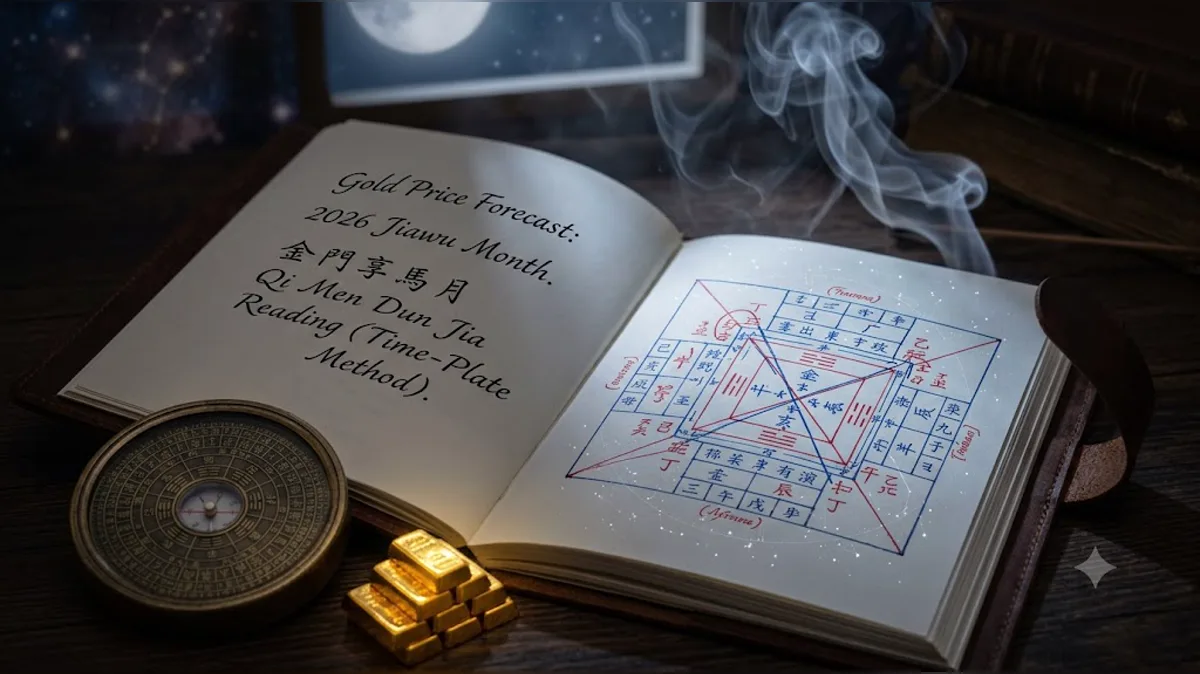
The archived version stated a casting time of June 10, 2026 at 17:04 and described a Qi Men reading for the Jia Wu month. It recorded three expectations:
- A generally uneven path with pressure first and stabilization later.
- A main pressure or low-probing window around June 14–20.
- A stabilization window around June 28–July 5.
A stated casting time and an editable WordPress publication date do not independently prove when the prediction became public. This review has not established an independently preserved, before-event copy. The original wording is retained in the editorial archive, but its chronology must be verified before it is used to advertise forecasting performance.
What can be checked against contemporary reporting
Reuters reporting on June 24, 2026, republished by MarketScreener, described gold falling to a more than seven-month low and trading below USD 4,000 per ounce. That dated observation falls four days after June 20. It is outside the first forecast window.
| Recorded claim | Editorial assessment |
|---|---|
| Pressure first, stabilization later | The reported late-June decline is consistent with the pressure portion. A broad directional description alone cannot establish predictive skill. |
| Low-probing window: June 14–20 | The later June 24 low is outside this window. Continuing pressure within a window is not equivalent to locating the low. |
| Stabilization window: June 28–July 5 | Not graded as a confirmed hit in this review. A benchmark, closing convention and numerical definition of stabilization must be specified before comparing the full price series. |
The earlier review used language such as “substantially accurate” and treated a four-day offset as a close result. Those assessments were too strong. The stated window must remain fixed after the outcome is known; widening it retrospectively would make the claim harder to falsify.
The chart evidence also needs a complete audit trail
The earlier article supplied pillars and some bureau information. Reusing those supplied labels is different from independently verifying the original chart. A complete audit should preserve the civil date and time, location, time zone and time convention; the Four Pillars; solar term and yuan; Yin or Yang Dun and bureau; Xun Shou, Duty Star and Duty Door; and a readable nine-palace plate.
The declared method is Time-based Rotating-Plate Chai-Bu, or 时家转盘拆补法. An auditor must also see the chosen significators, rejected alternatives, palace relationships and the derivation of each timing claim. Market outcomes cannot be used after the event to repair missing chart evidence. This page does not certify that the original chart and all of its interpretations have passed that audit.
What would make a future forecast testable
- Preserve a timestamped public copy before the forecast period begins.
- Define one instrument, benchmark, time zone, horizon and success criterion.
- Save the complete chart and the reasoning before the outcome.
- Score each dated window separately, including misses and ambiguous results.
- Report a series of cases instead of advertising an accuracy rate from one selected example.
Our methodology and source policy explain the tradition and editorial boundaries. They are not empirical proof that a divination method predicts financial markets.
Correction and review status
24 September 2026: This educational audit was revised with AI assistance. It removes the previous certainty about pre-event publication, chart sufficiency and a confirmed stabilization hit. A practitioner-reviewed forecast-performance claim requires the missing evidence described above. The article makes no recommendation to buy, sell or hold gold or any financial product.