
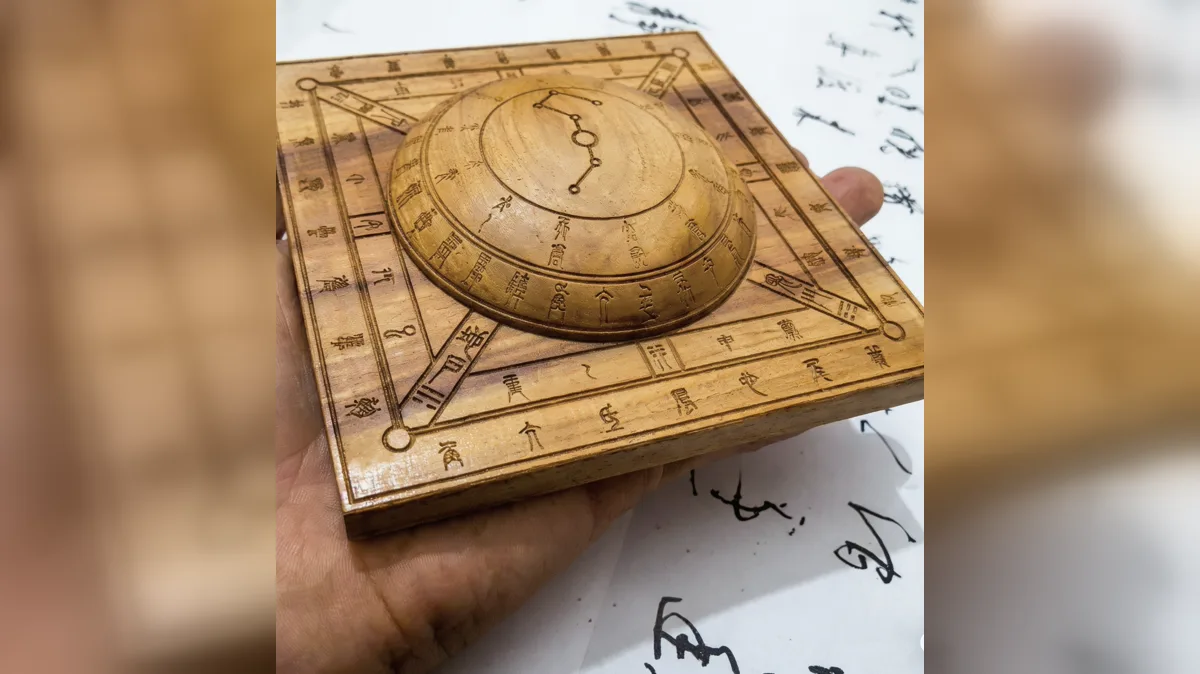

Da Liu Ren (大六壬) is a traditional Chinese system of situational divination. Its terminology concerns a question fixed at a particular time. A description of that tradition should not be confused with proof that it can predict an event accurately.
Two structures that should not be mixed
Readers encounter both mainstream Da Liu Ren and the Jin Kou Jue path. They use different chart structures. OracleEast’s current free tool and practical teaching material follow Jin Kou Jue’s Four Positions.
Mainstream Da Liu Ren
Introductions commonly describe Heaven and Earth Plates, Four Lessons (Si Ke), Three Transmissions (San Chuan), and Twelve Heavenly Generals. Four Lessons and Three Transmissions belong to that system. Listing them is not a complete derivation procedure and does not enable a reader to reproduce a chart.
Jin Kou Jue
The Four Positions are Human Origin 人元, Noble Spirit 贵神, General Spirit 将神, and Earth Division 地分. The fixed Monthly General 月将 is a calculation input used to derive General Spirit. It is neither a fifth position nor a replacement for Noble Spirit.
For the reproducible construction path and a clearly labelled teaching example, use the Jin Kou Jue Four-Position guide. Do not apply a Four Lessons tutorial to the output of a Four-Position calculator.
What information a reader should record
- One specific question and an observable result by a stated deadline.
- The casting date, local time, country, city and time zone.
- The declared school, calendar and time-correction convention.
- For Jin Kou Jue, the selected Earth Division convention and the complete Four Positions.
- The interpretation, contrary evidence and the later outcome, recorded separately.
Fix these inputs before interpreting the chart. Recasting until a desired answer appears, or changing the question after the event, prevents a meaningful check.
Uses and limits
Practitioners use situational divination to reflect on a focused matter, such as a pending response or an immediate choice. A symbolic indication cannot verify a supplier’s accounts, establish another person’s private intentions, diagnose illness, or replace evidence about a contract. Relevant records and professional advice remain necessary.
No independently measured accuracy rate is established by this page. Claims such as “the most accurate system” or “highly accurate when used correctly” need defined tests, complete samples and recorded misses. A successful-looking story alone does not provide that evidence.
Which guide fits your question?
For one matter, start with how to frame a Jin Kou Jue question and the free Four-Position tool. For several parties, options and stages within one strategic situation, read the Qi Men reading workflow. For long-term natal structure, see the BaZi introduction.
Editorial correction and references
24 September 2026: This page replaces earlier unsupported accuracy claims and distinguishes the mainstream structure from OracleEast’s Jin Kou Jue service. The overlapping “Emperor’s Oracle” introduction has been consolidated here. “Emperor’s Oracle” is not used as an accuracy credential.
The linked Four-Position guide identifies Zhang Deji’s teaching manual and the construction rules used by the current tool. See also Methodology & School Boundaries and Classical References & Editorial Standards. These are sources for traditional terminology, not proof of predictive causation. This educational revision was prepared with AI assistance.