

Da Liu Ren Jin Kou Jue (大六壬金口诀) is a compact event-divination method built around four positions: Human Origin, Noble Spirit, Monthly General, and Earth Division. This guide explains what those positions actually are, how a careful reader derives them, and why Jin Kou Jue should not be confused with the Four Lessons and Three Transmissions branch of Da Liu Ren.
Method note: OracleEast follows the Jin Kou Jue Four-Position framework in this article. It does not import Four Lessons, Three Transmissions, or formulas from other Da Liu Ren schools without clearly labeling them.
TL;DR — Jin Kou Jue in 30 seconds
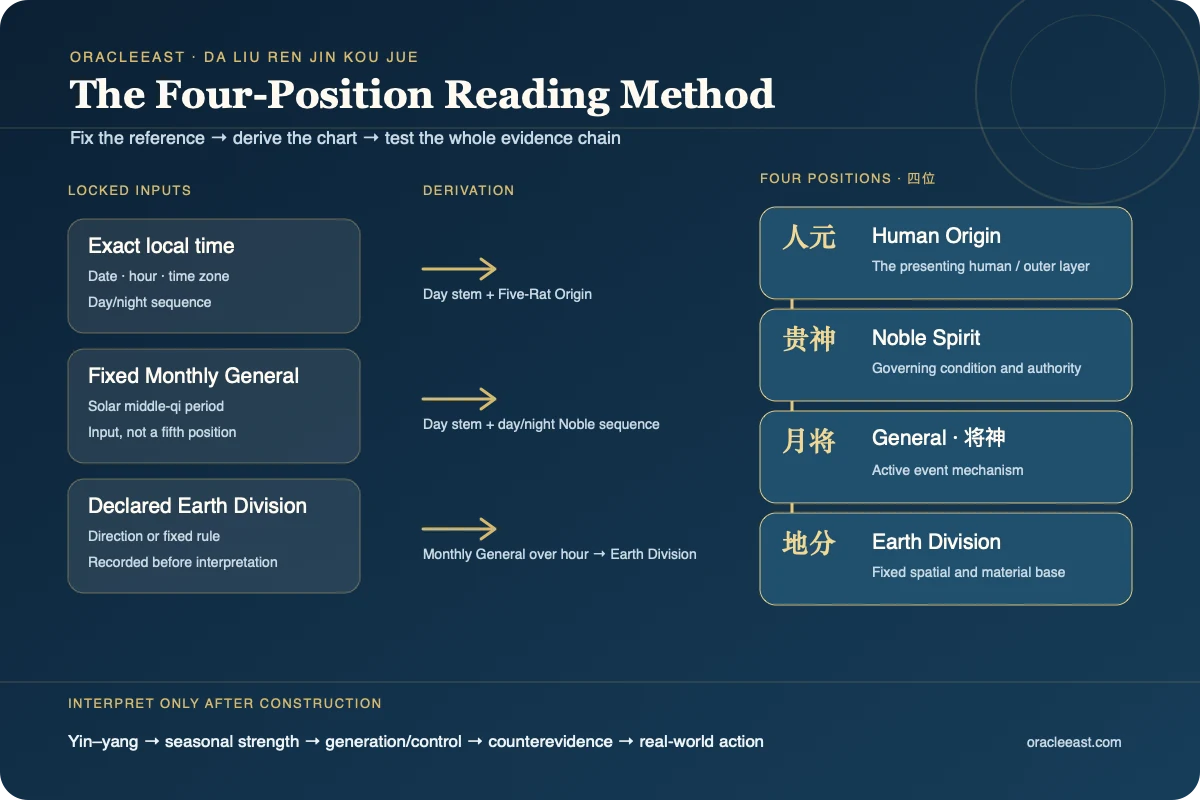
- Four Positions, not Four Lessons: the canonical frame is 人元 Human Origin, 贵神 Noble Spirit, 月将/将神 Monthly General, and 地分 Earth Division.
- The order matters: Earth Division fixes the spatial reference; time and the day stem are then used to derive the other positions.
- The fixed monthly general is an input, not a fifth position: once placed over the hour and counted to Earth Division, it becomes the active General used in the chart.
- A symbol is never a verdict: Five-Element generation and control must be weighed with seasonal strength, yin-yang, combinations, void, and counterevidence.
- Best use: one focused question about the present situation, leverage, blockage, timing, or the next practical action.
What is Da Liu Ren Jin Kou Jue?
Jin Kou Jue is a branch of the wider Liu Ren tradition that compresses a situational reading into a four-level chart. Classical and modern editions are often attributed to Sun Bin, but that attribution should be treated as traditional lineage language rather than verified authorship.
The method is sometimes described in English as “Golden Formula,” “Golden Mouth Formula,” or “Jin Kou Jue.” None of those translations is perfect. For search clarity, OracleEast keeps the romanized name and defines it directly:
- Da Liu Ren Jin Kou Jue (大六壬金口诀)
- A time-and-direction divination method that derives four positions, then judges their Five-Element relationships, strength, and symbolic roles against one focused question.
The best-known classical instruction is concise:
“入式之法妙通玄,月将加时方上传,更看何神同何位,日干须用五子元。”
A practical reading: place the Monthly General over the hour, identify the spirit at the chosen position, and use the day stem with the Five-Rat Origin method.
This compact verse describes calculation, not instant fortune-telling. A reliable reading still requires the reader to verify time, choose Earth Division consistently, distinguish day and night Noble Spirit sequences, derive the stems, identify the useful position, and test both supporting and conflicting evidence.
Jin Kou Jue versus mainstream Da Liu Ren
Jin Kou Jue and mainstream Da Liu Ren share calendars, Earthly Branches, the Twelve Generals, and Five-Element logic, but they do not use the same chart architecture.
| Question | Jin Kou Jue path | Four Lessons / Three Transmissions path |
|---|---|---|
| Core chart | Four Positions | Heaven/Earth plates, Four Lessons, Three Transmissions |
| Primary reference | Earth Division plus derived spirit/general positions | Day stem, day branch, lessons, transmissions |
| Reading style | Compact relational matrix | Extended causal and transmission analysis |
| Best fit | A focused, immediate question | A deeper event process requiring full transmission logic |
| OracleEast boundary | Used as its own method | Discussed separately; not mixed into this article |
Calling both systems “Da Liu Ren” does not make their steps interchangeable. Mixing the two may produce impressive terminology but an unauditable chart.
The Four Positions: what each level means
The Four Positions are a vertical evidence structure, not four free-floating symbols. Classical wording states, “夫课以人元、贵神、月将、地分为体” — the chart takes Human Origin, Noble Spirit, Monthly General, and Earth Division as its body.
In many modern manuals, the active Monthly General is called 将神, “General.” That is why readers may see the third row labeled either 月将 or 将神. The important distinction is this: the fixed monthly general used before counting is an input; the general that lands over Earth Division is the chart position.
| Order | Chinese | Working English | How it is obtained | What it anchors |
|---|---|---|---|---|
| 1, top | 人元 | Human Origin | Day stem is advanced by the Five-Rat Origin rule to Earth Division | External agency, the human layer, or the presenting side |
| 2 | 贵神 | Noble Spirit | Day stem + day/night Noble Spirit sequence, counted to Earth Division | Authority, condition, tone, and the governing spirit |
| 3 | 月将 / 将神 | Monthly General / General | Fixed monthly general is placed over the hour and counted to Earth Division | The active matter, movement, resources, and event mechanism |
| 4, base | 地分 | Earth Division | Chosen from a fixed direction or another declared, consistent rule | Place, object, material base, environment, and the source reference |
Earth Division is chosen first
Earth Division (地分) is the spatial anchor. The most traditional practical method uses the querent’s position relative to the reader: north is Zi, south is Wu, east is Mao, west is You, with the intermediate directions divided among the remaining branches.
Remote readings require a declared convention. A reader might use the direction of the matter, a fixed number-to-branch method, or another documented rule. What is not acceptable is choosing a branch after seeing which result looks favorable.
The Monthly General is time-derived
The fixed monthly general follows the traditional solar-term framework and changes at the relevant middle qi (中气), not on the first day of a Gregorian month. It is then placed over the hour branch and counted forward to Earth Division. The branch that arrives there becomes the active General in the Four Positions.
Noble Spirit and Human Origin are separate
Noble Spirit (贵神) is determined from the day stem and the applicable day or night sequence. Human Origin (人元) is not simply copied from the day stem. The Five-Rat Origin formula advances a stem from Zi to the selected Earth Division. The same method can also supply the stems attached to the Noble Spirit and General.
This is a major quality checkpoint. If a chart replaces Noble Spirit with a second “monthly general,” or writes the day stem directly as Human Origin without derivation, the Four-Position structure has not been built correctly.
A professional seven-step Jin Kou Jue workflow
A good Jin Kou Jue reading separates chart construction from interpretation. The following sequence makes the work auditable.
Step 1: Define one decision
Ask one concrete question: “Why is this application delayed?” is usable; “Tell me my whole future” is not. Record the decision deadline and what observable result would confirm or disconfirm the reading.
Step 2: Verify time and place
Record local date, clock time, time zone, daylight-saving status, and location. These determine the day stem, hour branch, monthly general, and day/night Noble Spirit sequence. For a remote session, document which location and Earth Division rule are being used.
Step 3: Fix Earth Division
Choose Earth Division from the actual relative direction or the declared remote convention. Write the rule beside the chart. Do not change it later to improve the result.
Step 4: Derive the active General
Identify the fixed monthly general for the solar-term period. Place it over the hour branch and count to Earth Division. The arriving branch is the active Monthly General, often labeled 将神.
Step 5: Place Noble Spirit
Use the day stem to identify the proper Noble Spirit starting point, determine whether the chart uses the day or night sequence, and count in the prescribed direction to Earth Division.
Step 6: Derive Human Origin and stems
Use the Five-Rat Origin rule from the day stem to advance a Heavenly Stem from Zi to Earth Division. Apply the same stem-derivation logic to the General and Noble Spirit branches when a full stem-branch chart is required.
Step 7: Judge the whole matrix
Only now assess yin and yang, the useful position, seasonal strength, generation and control, combinations, clashes, void, movement markers, and question-specific symbolism. Translate the result into:
- the strongest chart signal;
- the mechanism that explains it;
- counterevidence that could change the conclusion;
- a real-world condition to verify;
- a practical next action.
That evidence chain is the difference between a symbolic slogan and a professional reading.
Worked construction example from a modern teaching text
This example demonstrates construction only; it is not a client testimonial or an outcome claim. Zhang Deji’s teaching manual gives a chart for a Geng-Yin day, Wu hour, with the querent located in the southwest Shen direction.
The manual derives the chart as follows:
| Level | Derived value | Construction note |
|---|---|---|
| 人元 Human Origin | 甲 Jia Wood | On a Geng day, the Five-Rat Origin starts Bing at Zi and advances to Shen |
| 贵神 Noble Spirit | 甲申 White Tiger | The daytime Noble Spirit sequence for a Geng day reaches White Tiger at Shen |
| 将神 General | 辛巳 Tai Yi | The Xu-month fixed general Mao is placed over Wu hour and counted to Shen |
| 地分 Earth Division | 申 Shen Metal | The querent’s southwest position supplies the fixed spatial branch |
The example matters because every row can be traced to a rule. It also shows why the correct four-level diagram is Human Origin → Noble Spirit → General → Earth Division. The fixed monthly general used at the start of Step 4 does not become an extra fifth row.
No responsible practitioner should force a verdict from this construction without a declared question. The same White Tiger, Tai Yi, or Metal-Wood relation can describe different real-world roles depending on whether the subject is a missing object, a contract, a journey, a dispute, or a health concern.
How Jin Kou Jue becomes practical decision support
Jin Kou Jue is most useful when symbolic evidence is converted into testable conditions. A reader should never stop at “auspicious” or “inauspicious.”
For example, if the governing spirit controls Human Origin, the first inference is that the other side, institution, or prevailing condition holds more leverage. That is not yet a rejection. Seasonal strength, the General, the material base in Earth Division, and supportive positions determine whether the control means scrutiny, delay, discipline, containment, or a completed refusal.
OracleEast uses a five-part translation:
| Chart layer | Practical question |
|---|---|
| Signal | Which position is strongest or most activated? |
| Relation | Who generates, controls, drains, or supports whom? |
| Strength | Does the season give that relation enough force to matter? |
| Countercheck | Which position contradicts the first impression? |
| Action | What document, conversation, deadline, safeguard, or waiting period can verify the interpretation? |
This approach keeps traditional terminology while preventing the chart from replacing ordinary evidence. Legal filings still require legal review. Medical symptoms still require qualified care. Financial commitments still require due diligence.
Seven common Jin Kou Jue mistakes
Most beginner errors come from mixing schools or skipping derivation.
| Mistake | Why it fails | Professional correction |
|---|---|---|
| Calling Four Lessons and Three Transmissions “Jin Kou Jue” | Uses a different chart architecture | Declare the school before calculating |
| Omitting Noble Spirit from the Four Positions | Removes a canonical layer | Use Human Origin, Noble Spirit, General, Earth Division |
| Treating fixed monthly general and active General as two chart rows | Confuses input with derived position | Show the fixed general in the calculation note, not as a fifth position |
| Copying the day stem directly into Human Origin | Skips Five-Rat Origin derivation | Advance the stem to Earth Division |
| Switching the monthly general on a calendar-month boundary | Misaligns the solar-term input | Check the relevant middle qi |
| Choosing Earth Division after reading the chart | Makes the result unfalsifiable | Lock and record the selection rule first |
| Letting one “good” or “bad” spirit decide the answer | Ignores strength and counterevidence | Judge the whole Four-Position matrix |
Special note for overseas and remote clients
Remote Jin Kou Jue work needs less personal data, but more methodological transparency. For one focused question, OracleEast may need the exact question time, country and city, and the agreed Earth Division convention. A street address, company name, or telephone number is unnecessary.
Time-zone history and daylight-saving time matter because the civil date or hour can shift the day stem and hour branch. Direction also needs a stable reference: “east of the reader,” “direction of the destination,” and “number converted to an Earthly Branch” are not interchangeable conventions.
Before paying any practitioner, ask for three things:
- the Four Positions in writing;
- the rule used to choose Earth Division;
- the evidence chain from chart signal to practical recommendation.
If the reader cannot show those steps, polished language cannot make the reading auditable.
What an OracleEast Jin Kou Jue consultation should provide
A professional consultation should show its work and preserve human responsibility. OracleEast paid readings are manually analyzed, written, and reviewed by a practitioner. AI may assist with chart calculation or administration, but it is not presented as the author of the paid report.
A useful deliverable should include the locked input time, Earth Division rule, complete Four Positions, strength and relationship analysis, supporting and conflicting evidence, a direct conclusion, and practical safeguards. It should also state where the chart cannot replace legal, medical, financial, or other professional advice.
For one focused issue and its decision deadline, see OracleEast’s Decision Timing service. Current scope and pricing are always governed by the live website.
Frequently asked questions
Is Jin Kou Jue the same as Da Liu Ren?
Jin Kou Jue belongs to the broader Liu Ren tradition, but it is not identical to the mainstream Four Lessons and Three Transmissions method. It uses a compact Four-Position chart and should be taught as a distinct calculation path.
What are the Four Positions in Jin Kou Jue?
The canonical four are Human Origin (人元), Noble Spirit (贵神), Monthly General or General (月将/将神), and Earth Division (地分). The fixed monthly general used during calculation is the input that derives the active General.
Is Human Origin just the day stem?
No. Human Origin is derived from the day stem with the Five-Rat Origin rule and advanced to the selected Earth Division. Copying the day stem directly skips a required calculation.
How is Earth Division chosen for an online reading?
There is more than one transmitted convention. The reader must declare and lock the rule before calculation—for example, the direction of the matter or a fixed number-to-branch method. Changing the rule after seeing the chart invalidates the process.
Can Jin Kou Jue give a guaranteed yes-or-no answer?
No. It can support a conditional judgment about leverage, blockage, timing, and likely development. A professional reading names counterevidence and observable conditions rather than promising certainty.
What information does OracleEast need?
For a focused event reading, usually the question, exact question time, country and city, decision deadline, and the agreed direction convention. OracleEast does not need a street address, company name, or phone number.
Sources and further reading
- OracleEast: Da Liu Ren overview
- OracleEast methodology and school boundaries
- OracleEast classical references and editorial standards
- OracleEast Da Liu Ren article library
- Google Books bibliographic record: 六壬神课金口诀
- WorldCat: 米鸿宾校注《六壬神课金口诀心髓指要》
- 张得计,《金口诀教程》上册,第四章“金口诀起课方法”,原书物理页 40–45。
- 米鸿宾校注,《六壬神课金口诀心髓指要》,北京古籍出版社,2004。
About the author and method
Joy Hu is OracleEast’s lead practitioner and reviewer, a Peking University postgraduate and former senior executive at publicly listed companies. Joy has studied and practiced Chinese metaphysics for 20 years, including Zi Ping BaZi, Ni-school Zi Wei Dou Shu, time-based Rotating-Plate Chai-Bu Qi Men Dun Jia, and Da Liu Ren Jin Kou Jue.
Disclaimer: This article is for cultural education and analytical discussion. Jin Kou Jue is a traditional interpretive system. It does not provide medical, legal, investment, immigration, or relationship advice, and it does not replace evidence-based professional judgment.
Last updated: August 6, 2026
Update: First publication with corrected Four-Position terminology, a sourced construction example, SEO/GEO structure, and original visual assets.