

BaZi analysis is not element counting or a list of personality keywords. It is a structured reading of the Day Master, birth season, Ten Gods, chart architecture, and timing cycles. This guide shows the seven-step method a careful practitioner uses—and the shortcuts a calculator cannot safely make.
Method note: This article follows the Zi Ping school (子平派). The Day Master is the reference point, the Month Branch establishes season, and the whole chart is judged before any single symbol.
TL;DR — BaZi analysis in 30 seconds
- Start with correct data: Time zone, daylight-saving time, local solar time, and solar-term boundaries can change a pillar.
- Read relationships, not totals: A missing element is not automatically bad, and a frequent element is not automatically useful.
- Sequence matters: Season and roots come before Ten Gods; natal structure comes before Luck Pillars and annual timing.
- Use three lenses: Structure, strength/balance, and climate regulation answer different questions and should not be collapsed into one rule.
- Treat timing as conditional: A Luck Pillar activates the natal chart; it does not replace it or guarantee an event.
What is a BaZi analysis?
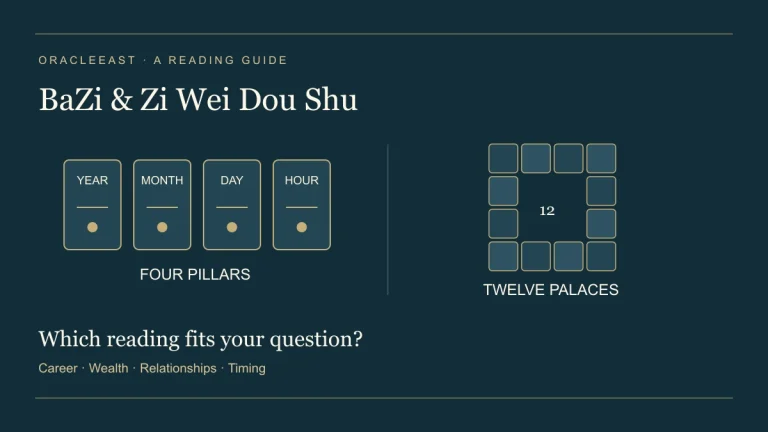
A BaZi analysis is a relational reading of eight characters arranged in four pillars: year, month, day, and hour. Each pillar contains a Heavenly Stem and an Earthly Branch. The Day Stem—the Day Master (日主)—represents the person being analyzed, while the other characters are interpreted through generation, control, polarity, seasonal strength, combinations, clashes, and timing.
This is why two charts with the same five-element totals can behave differently. One may have Wood rooted in spring and supported by Water; another may show an isolated Wood stem in autumn Metal. A calculator can count both as “one Wood,” but a practitioner must ask whether that Wood is timely, rooted, supported, transformed, or controlled.
The Zi Ping tradition also separates three questions that online summaries often blend together:
- What is the natal structure? This describes the chart’s baseline organization.
- Which forces help or disrupt that structure? This is the work of useful-factor analysis.
- When is the structure activated? This is examined through ten-year Luck Pillars and annual pillars.
For a foundation before using this framework, read OracleEast’s complete guide to BaZi and the Four Pillars.
Why birth data verification comes first
A reading cannot be better than the chart it starts from. Professional BaZi analysis begins by checking the birth date, approximate or exact birth time, birth city and country, historical time zone, daylight-saving rules, and proximity to a solar-term boundary.
BaZi months do not begin on the first day of a lunar or Gregorian month. They change at the solar jie (节). The year pillar also changes at Li Chun (立春) in the common Zi Ping convention, not automatically on January 1 or Lunar New Year. A birth close to Li Chun or another seasonal boundary must therefore be calculated against the actual transition time.
Location matters because civil clock time and local solar time are not identical. For someone born overseas, the city is used to correct longitude and historical time-zone rules; a street address is unnecessary. If the hour is uncertain, a responsible reading labels which conclusions remain stable across the possible hour pillars.
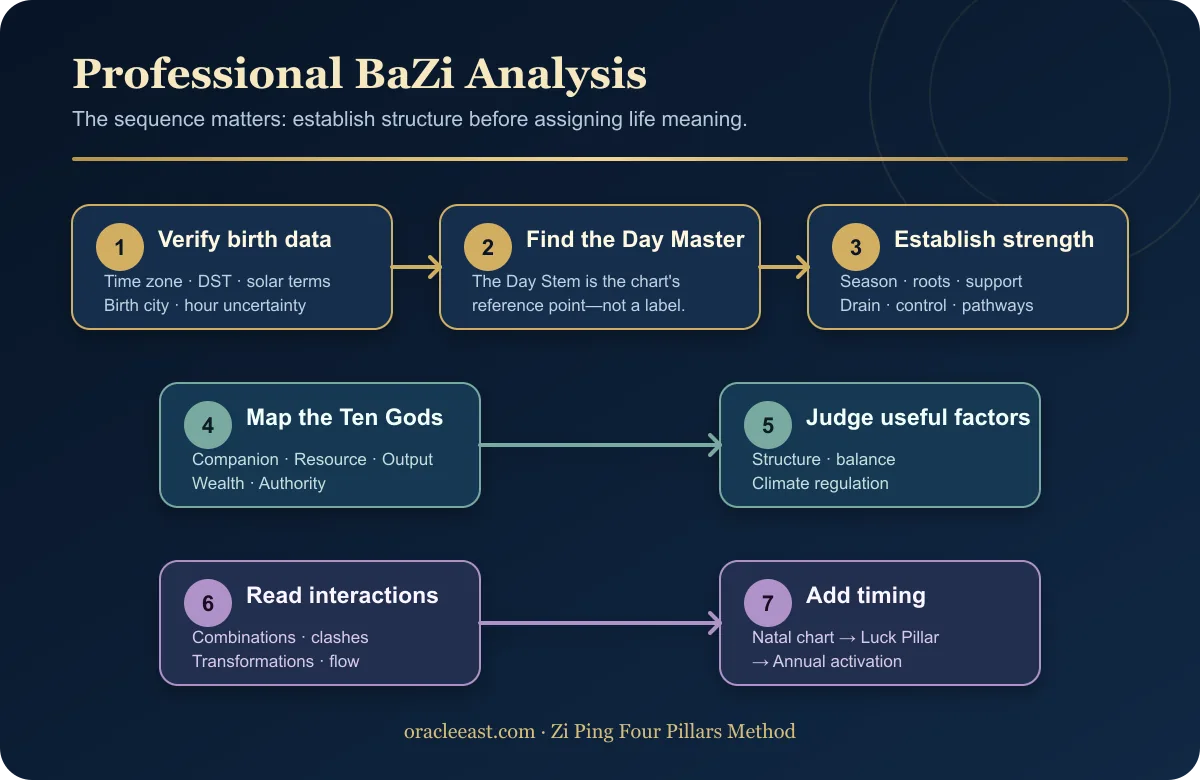
The professional seven-step BaZi analysis framework
The correct order prevents a common error: assigning life meanings before the chart’s physical structure has been established. Each step answers a different question.
Step 1: Build and verify the Four Pillars
Confirm the year, month, day, and hour pillars using solar terms and location-aware time. Record the Heavenly Stems, Earthly Branches, hidden stems, and the ten-year Luck Pillars. If the time is approximate, calculate the adjacent candidate hours rather than pretending to have false precision.
Step 2: Identify the Day Master
The Day Master is the Heavenly Stem of the Day Pillar. It is the reference point for every Ten God relationship. A Geng Metal Day Master and a Yi Wood Day Master may encounter the same Ren Water, but that Water performs a different role in each chart.
The Day Master is not a complete personality label. “Jia Wood people are leaders” is too general to be analysis. The question is how the Day Master functions inside this specific season, set of roots, and pattern of support or restraint. See the detailed BaZi Day Master guide.
Step 3: Establish season, roots, and strength
The Month Branch is the first major reference for seasonal qi. Then check whether the Day Master has roots in the Earthly Branches, receives support from Resource, gains help from Companion stars, or is drained and controlled by Output, Wealth, and Authority.
Classical balance theory is concise: “身旺者,则宜泄、宜伤;身衰者,则喜扶、喜助” — when the self is strong, release or restrain it; when weak, support or assist it — in Yuan Hai Zi Ping (渊海子平). The rule is a starting principle, not permission to classify strength by counting colors in a chart.
Step 4: Map the Ten Gods
The Ten Gods translate five-element relationships into functions: Companion, Resource, Output, Wealth, and Authority, each divided by yin-yang polarity. They can describe how a person learns, expresses, competes, manages resources, and responds to structure.
| Relationship to Day Master | Ten Gods | Practical domain |
|---|---|---|
| Same element | Friend / Rob Wealth | peers, autonomy, competition |
| Produces Day Master | Direct / Indirect Resource | learning, support, protection |
| Produced by Day Master | Eating God / Hurting Officer | output, craft, communication |
| Controlled by Day Master | Direct / Indirect Wealth | resources, execution, money behavior |
| Controls Day Master | Direct Officer / Seven Killings | responsibility, pressure, authority |
No Ten God is inherently good or bad. Seven Killings can indicate pressure without control, or disciplined leadership when properly integrated. Hurting Officer can challenge rigid authority, yet also describe precise expression and innovation. Context decides function. For all ten relationships, use the Ten Gods in BaZi guide.
Step 5: Determine structure and useful factors
Useful-factor analysis is not “find the missing element.” A careful reader compares at least three lenses:
- Structure / month-order lens: What configuration emerges from the Month Branch and visible stems? What preserves or damages that structure?
- Strength and balance lens: Does the Day Master need support, release, or restraint?
- Climate-regulation lens: Is the chart excessively cold, hot, dry, or damp for its seasonal context?
The climate lens is grounded in the classical observation, “天道有寒暖,发育万物,人道行之,不可过也” — Heaven has cold and warmth by which all things develop; in human affairs neither should become excessive — from Di Tian Sui Chan Wei (滴天髓阐微).
These lenses may point in the same direction, but not always. When they conflict, the analysis should explain why one priority is chosen instead of quietly switching theories mid-reading.
Step 6: Read combinations, clashes, and pathways
Stems and branches interact through combinations, clashes, harms, punishments, meetings, and three-harmony frames. Yet a named interaction is not a verdict. A combination does not always transform, and a clash does not always mean disaster.
Ask four questions: Is the interaction supported by season? Does it involve a root or only a floating stem? Which functional star is affected? Does the interaction connect a useful pathway or interrupt it? This converts symbolic vocabulary into an auditable chain of reasoning.
Step 7: Add Luck Pillars and annual timing
The natal chart is the baseline; Luck Pillars (大运) are ten-year environments, and annual pillars are shorter triggers. Timing analysis looks for repeated activation: a new stem revealing a latent function, a branch completing a frame, a clash moving an important palace, or an annual pillar intensifying the current decade.
One year should never be read in isolation. The same annual Wood may help one chart, overload another, and remain minor in a third. Learn the timing layer in Luck Pillars in BaZi: 10-Year Cycles Explained.
A complete teaching chart: why counting elements fails
The following is a synthetic teaching example, not a client case or testimonial. One reproducible hypothetical input that yields these pillars is 19 February 1924, 18:00 local civil time, Hong Kong (UTC+8, no daylight saving). The longitude and equation-of-time correction keeps the time within the You hour (17:00–19:00 solar time). The year is after Li Chun and the month is before Jing Zhe. The Four Pillars were cross-checked using two calculation implementations. This example demonstrates structural relationships only; it does not claim a real person’s history or supply Luck Pillar or event predictions.
| Pillar | Year | Month | Day | Hour |
|---|---|---|---|---|
| Heavenly Stem | 甲 Jia Wood | 丙 Bing Fire | 戊 Wu Earth | 辛 Xin Metal |
| Earthly Branch | 子 Zi Water | 寅 Yin Wood | 辰 Chen Earth | 酉 You Metal |
| Hidden Stems | 癸 | 甲・丙・戊 | 戊・乙・癸 | 辛 |
| Role to Wu Earth | Seven Killings / Direct Wealth | Indirect Resource + roots | Day Master + Officer/Wealth | Hurting Officer |
The naive reading says: “All five elements appear, so the chart is balanced.” The professional reading starts elsewhere.
First, 寅 is the Month Branch, so spring Wood holds seasonal authority. Second, Wu Earth has a root in 辰 and another hidden root in 寅, while Bing Fire provides Resource support. Third, Jia Wood/Seven Killings applies pressure, and Xin Metal/Hurting Officer can counter Wood—but Metal itself is not seasonally dominant in early spring. Direct Wealth is present as hidden Gui Water in 子 and 辰.
The conclusion is not a fortune prediction. It is a structural question: Are the Fire support and Earth roots sufficient to let Wu Earth productively carry Authority and Output, or does spring Wood pressure dominate? A full reading would then test combinations, visible pathways, climate, and Luck Pillars. This chain is more rigorous than declaring “Earth weak” or recommending more Earth from a five-element count.
How BaZi analysis addresses career, wealth, and relationships
BaZi does not assign one element to one profession or promise a financial outcome. It shows functional patterns and timing conditions that can be compared with real choices.
Career
Career analysis compares Output, Resource, Authority, Wealth, the Month Branch, and the chart’s useful pathways. A strong Output-to-Wealth pathway may favor turning expertise into deliverables; Resource and Authority may support credentialed or structured work. The actual recommendation must still consider skills, industry conditions, immigration status, and personal goals.
Wealth
Wealth stars describe how the Day Master controls and deploys resources; they are not a bank-balance guarantee. A chart must be able to carry Wealth, and timing must support execution. Concentrated Wealth without sufficient capacity can describe workload, obligations, or unstable resource management rather than effortless money.
Relationships
Relationship analysis includes the Day Branch (often called the spouse palace), relevant Ten Gods, combinations and clashes, and timing. It can describe needs, friction patterns, and periods of change, but it cannot override consent, communication, or observable behavior.
Five common BaZi analysis mistakes
Most poor readings fail because they skip sequence or turn a conditional rule into an absolute slogan.
| Mistake | Why it fails | Better practice |
|---|---|---|
| “Missing element = bad” | Absence may protect the chart or be supplied by timing | Judge structure and function first |
| Counting elements to decide strength | Ignores season, roots, and combinations | Start with Month Branch and rooted support |
| Treating a Ten God as always lucky or unlucky | Every role changes by context | Trace its effect on the whole chart |
| Reading one annual pillar alone | Ignores the natal baseline and current decade | Read natal → Luck Pillar → year |
| Forcing an exact prediction from uncertain birth time | Creates false precision | Compare adjacent hour pillars and label stable findings |
Special note for people born overseas
Overseas birth data needs historical time-zone care, not extra personal information. Daylight-saving rules have changed across countries and decades. Civil time, longitude-based solar time, and the exact solar-term transition may place a borderline birth in a different hour, day, month, or year pillar.
OracleEast only needs the birth date, birth country, birth city, approximate time, and an email for delivery. If the time is unknown, state that it is unknown. We do not ask for a street address, company name, or phone number. If you want to see the raw Four Pillars first, use the free BaZi chart and starter reading.
What to expect from a professional BaZi reading
A useful reading should show its work. It should state the chart, method, central structural judgment, supporting and conflicting evidence, timing windows, and where uncertain data limits confidence. It should also translate every technical conclusion into a practical question the client can verify.
OracleEast paid BaZi reports are manually analyzed, written, and reviewed by a practitioner. Automated tools may assist with chart calculation and administration, but they are not presented as the author of the paid report. To compare reading options, visit the OracleEast BaZi guide and services page.
Frequently asked questions about BaZi analysis
Is BaZi analysis the same as Chinese zodiac analysis?
No. The popular Chinese zodiac uses only the year branch—one of eight characters. BaZi uses the year, month, day, and hour pillars, plus hidden stems, seasonal strength, Ten Gods, interactions, and timing cycles.
Do I need my exact birth time for a BaZi reading?
Exact time is helpful because it determines the Hour Pillar, but an approximate range can still support a responsible analysis. The reader should compare the possible hour pillars and separate stable conclusions from time-sensitive ones.
Can a BaZi calculator perform a full analysis?
A calculator can generate pillars and basic relationships. It usually cannot resolve conflicting structures, transformation conditions, climate priorities, uncertain birth time, or the interaction between natal chart, Luck Pillar, and annual timing with practitioner-level judgment.
Is a missing element always unfavorable?
No. Missing does not mean needed. An absent element may be neutral, may protect the structure, or may become useful only in a particular timing cycle. Useful factors are determined from the whole chart, not a color chart.
Can BaZi predict an exact event or guarantee success?
No. BaZi describes patterns, capacities, pressures, and timing conditions. It can frame better questions and identify periods worth monitoring, but choices, health care, law, finance, relationships, and external conditions require real-world evidence and qualified professional advice.
How often should a BaZi analysis be updated?
The natal chart does not change. A full foundational reading is usually done once, while timing reviews may be useful when entering a new ten-year Luck Pillar or planning a major transition. Repeating generic annual readings without reference to the natal chart adds little value.
Sources and further reading
- BaZi explained: Four Pillars, Five Elements, and Ten Gods
- BaZi Day Master explained
- Ten Gods in BaZi
- Luck Pillars in BaZi
- Yuan Hai Zi Ping (渊海子平), Chinese Text Project
- Di Tian Sui Chan Wei (滴天髓阐微), Chinese Text Project
- Wan Minying, San Ming Tong Hui (三命通会), Ming dynasty
- Shen Xiaozhan, Zi Ping Zhen Quan (子平真诠), Qing dynasty
About the author and methodology
Joy Hu is OracleEast’s lead practitioner and reviewer, a Peking University postgraduate and former senior executive at publicly listed companies. Joy has studied and practiced Chinese metaphysics for 20 years, focusing on Zi Ping BaZi, Ni-school Zi Wei Dou Shu, time-based Rotating-Plate Chai-Bu Qi Men Dun Jia, and Da Liu Ren Jin Kou Jue. For questions, use the OracleEast contact page.
Disclaimer: This article is for cultural education and analytical discussion. It does not provide medical, legal, investment, or relationship advice. BaZi is a traditional interpretive system, not a substitute for evidence-based professional judgment.
Last updated: October 2, 2026
Update: Added reproducible hypothetical inputs for the teaching chart, cross-checked the Four Pillars, and clarified the required birth data.