
You ask about your career. A BaZi reading suggests that this is a good time to pursue a more senior role. A Zi Wei Dou Shu reading points to mounting pressure. Both sound plausible, yet you are left with a more difficult question: which reading should you trust?
A promotion and greater pressure can happen together. What you actually need to know is whether you will get the role, whether your income will rise, and whether the extra responsibility is worthwhile. Until those questions are separated, the two readings cannot meaningfully be compared.
1. The underlying method: relationships between elements or relationships between palaces
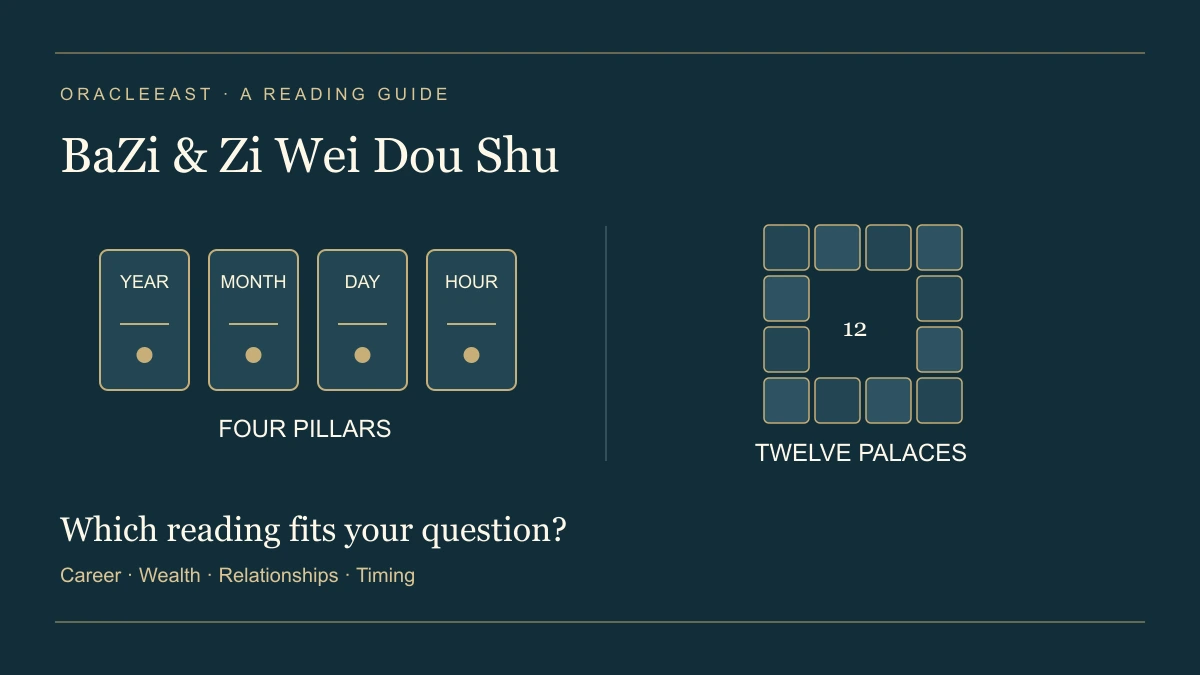
BaZi, or the Four Pillars of Destiny, organizes the birth year, month, day and hour into four pillars. The Day Master—the Heavenly Stem of the day pillar—provides the reference point for examining the seasonal context, the relative strength of the Five Elements, and the relationships known as the Ten Gods. Ten-year luck cycles and annual influences add the timing layers.
Terms such as Wealth, Officer and Resource describe relationships within the system. They are not literal entries for your bank balance, job title or educational qualifications. Finding three Wealth symbols does not establish that someone will be richer than a person with one. Their source, support and relationship to the rest of the chart matter.
The classical text Zi Ping Zhen Quan, in its chapter on the useful influence, emphasizes the month branch and the need to weigh the stems and branches together. Its reasoning depends on the configuration, rather than the mere presence of a named symbol. Read the original chapter in Chinese.
Zi Wei Dou Shu arranges symbolic stars across twelve palaces. A reading considers the Life and Body palaces, star combinations, and the connected palaces described by san fang si zheng. For the Life Palace, the Wealth, Career and Travel palaces are important reference points. One principal star is not enough to characterize an entire life. This connected approach appears in Zi Wei Dou Shu Quan Shu, Volume Three.
The Zi Wei discussion here follows OracleEast’s Ni Haixia Tian Ji approach. Rules from different schools are not silently combined within the same judgment.
2. Career: separate the title, the pay and the way you work
In traditional BaZi interpretation, Officer and Seven Killings relationships concern rules, responsibility and pressure. Resource relates to support and learning; Output to expression and production; and Wealth to resources and exchange. A substantive reading explains how these relationships work together. An Officer symbol alone is not a reason to recommend a government career, just as an Output symbol alone is not a reason to recommend entrepreneurship.
One distinction in Zi Ping Zhen Quan illustrates the point. It treats “Direct Officer supported by Resource” differently from “Resource making use of Officer.” Both contain Officer and Resource, but the organizing relationship differs: the first concerns support for an Officer structure, while the second concerns nourishment of a Resource structure. Reducing both to “well educated and suited to leadership” loses the distinction the text is making.
Zi Wei can begin with the Career Palace and examine its relationship with Life, Wealth and Travel: how a person’s role, income, way of operating and external environment fit together.
If you are choosing a career direction, begin with how you earn income and recognition. If you are considering a particular position, ask separately about its responsibilities, compensation and location. A better title without better pay is a different outcome from higher pay with less autonomy. Neither is adequately described by the phrase “good career luck.”
3. Wealth: earning, retaining and accumulating are different questions
A BaZi wealth reading does not rank people by the number of Wealth symbols in their charts. It examines whether Output supports Wealth, whether Wealth has a foundation, whether the Day Master can carry the configuration, and how the timing cycles alter those relationships. A strong Day Master does not automatically mean wealth; a weak one does not automatically mean poverty.
In Zi Wei, the Wealth Palace is an entry point for financial themes, but income, employment and accumulated assets cannot all be reduced to one palace. Career and Property, among other relevant palaces, need to be considered within their wider combinations.
A useful wealth consultation should therefore address where income comes from, where resources tend to be depleted, and which periods deserve closer attention. “You have Wealth in your chart” does not answer the question of accumulation. Nor can these traditional symbols be converted directly into a dollar amount or an investment return.
4. Relationships: BaZi has a spouse palace, and Zi Wei is more than its Spouse Palace
The claim that “Zi Wei is for marriage, while BaZi only describes broad trends” is too simplistic.
BaZi relationship analysis commonly considers the day branch as the spouse palace, relevant Ten Gods relationships, their interactions, and the timing cycles that activate them. Zi Wei uses the Spouse Palace as an important starting point, together with connected palaces, star combinations and timing. Both have a framework for examining relationships.
What matters is whether the interpretation distinguishes a partner’s characteristics, the couple’s interaction patterns and an actual relationship event. A strong-willed partner does not, by itself, imply a failed marriage. Increased relationship pressure in a particular year cannot simply be relabeled as divorce.
If your question is why you and your partner repeatedly clash over career arrangements, that conflict should remain the focus. A list of personality traits, physical features, romantic prospects and possible marriage years does not necessarily answer it.
An individual relationship reading is also different from a compatibility reading for two people. One person’s chart cannot establish that a full assessment of both partners has been completed. Each chart needs to be understood before considering their interaction. Matching or clashing zodiac animals alone should not determine whether a relationship continues.
5. Timing: a more precise prediction is not necessarily a more accurate one
BaZi distinguishes the natal configuration, ten-year luck cycles and annual influences. Zi Wei likewise combines the natal chart, major periods and annual changes. The idea that BaZi can only discuss decades while Zi Wei alone can identify particular years misrepresents both methods.
A timing judgment needs a chain of reasoning: what supports the interpretation in the natal chart, how the broader period relates to it, and what the year is said to activate. A zodiac animal or a single annual star cannot supply that entire chain.
“Something will change in your work, relationship or home next year” is difficult to evaluate. A question such as “Will I obtain a formal management position at my current employer within the next twelve months?” defines a domain, a time window and an observable result. This is an example of a well-framed question, not a prediction about the reader.
When reviewing earlier predictions, record the misses as well as the hits. Rewriting a statement after an event to make it fit does not turn it into a successful prediction.
6. Birth time: uncertainty affects both systems
A change in the hour pillar can alter a BaZi configuration and its interpretation. In Zi Wei, birth time also affects the placement of the Life and Body palaces and certain stars. Near a time boundary, choosing a chart because its personality description “sounds like me” is not a sufficient check.
Without a reliable birth hour, BaZi can still discuss some information supplied by the year, month and day. That should not be presented as a complete reading. Zi Wei likewise calls for comparison of plausible charts, with a clear account of which conclusions remain stable and which change.
For people born overseas, the local time zone, daylight-saving rules and chosen time-correction convention also need attention. The less certain the inputs, the more important it is to resolve the chart’s basis before purchasing a longer report.
7. Reading both charts: the real test is how disagreements are handled
A combined reading should ask both systems the same question. For example, both should address whether a formal management appointment is indicated within the next year. A BaZi discussion of wealth and a Zi Wei discussion of romance cannot be counted as agreement.
When the readings conflict, check the birth information and calculation conventions first. Then ask whether both interpretations concern the same period and the same event. Finally, examine the completeness of each line of reasoning. BaZi should not win by default, and a longer list of Zi Wei terms should not automatically overrule it.
An unexplained disagreement should remain unresolved. The two charts use shared birth information and may be interpreted by the same person; they are not two fully independent tests. Agreement alone does not demonstrate an increase in accuracy.
A sound combined report should explain what both methods support, where they disagree, which conclusion is adopted, and why.
Which reading should you choose?
| Your main question | A useful starting point |
|---|---|
| Career direction, income patterns and longer-term phases | BaZi to establish the main structure |
| How marriage, work or relocation connects with other areas of life | A focused Zi Wei reading |
| Two existing interpretations that contradict each other | Review the same proposition before commissioning a combined reading |
| An uncertain birth time | Verify the information and compare plausible charts first |
These suggestions match the form of the analysis to the question. They do not establish that one system has been proven more accurate in a particular domain. Classical sources explain the methods; this article does not have comparative evidence sufficient to assign them a universal accuracy ranking.
If you are facing a career transition, a relationship decision or a move, start by putting your most important question into one sentence. Before buying a report that covers everything, look for a practitioner who can explain the judgment, its basis and its timing for the issue that matters most to you.
Explore the available OracleEast consultations. For a Zi Wei topic or a combined BaZi–Zi Wei reading, describe your question and confirm the scope first. The existing BaZi report should not be assumed to include an analysis of both charts.
Paid reports are manually analyzed, written and reviewed by a practitioner. They are not AI-generated reports; software is used only to assist calculation or administration. The birth information requested is limited to your email, birth date, birth country, birth city and approximate birth time. Country and city are used for true-solar-time correction. If the time is uncertain, say so. No street address, company name or phone number is required.
About this guide: AI-assisted educational content. Editorial contact: Joy Hu, OracleEast. The manual-delivery commitment above applies to paid client reports.