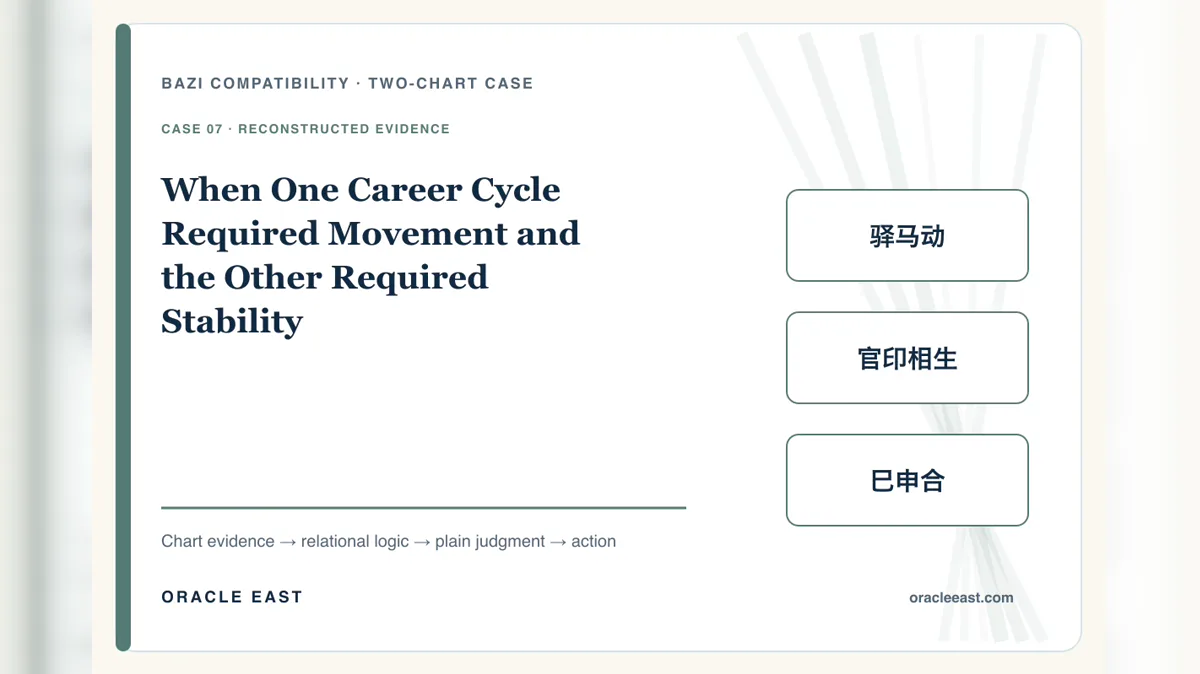

A BaZi relocation compatibility case shows how a sound relationship can face one partner’s expansion cycle and the other’s stability cycle.
The decision behind the chart
What was fixed before interpretation
Compatibility is read from two complete Zi Ping BaZi structures. We compare each Day Master, the partner indicators, both relationship palaces, and the timing each person is entering. A single clash or favorable combination is never enough.
Evidence status: Two complete composite charts are shown. The conflict is read as a timing mismatch rather than proof of emotional incompatibility.
Partner A · expansion cycle
| Y | M | D | H |
|---|---|---|---|
| 壬寅 | 丙午 | 甲申 | 戊辰 |
Output generates Wealth; the 寅申 axis activates movement and a wider market. Staying can cost the main growth mechanism.
Partner B · consolidation cycle
| Y | M | D | H |
|---|---|---|---|
| 辛亥 | 壬子 | 乙巳 | 癸未 |
Authority and Resource reinforce credentials, institutional status and property planning. Leaving prematurely breaks the useful sequence.
How the chart becomes a judgment
Skill and visibility feed Wealth, so movement, new markets and a broader professional field are not distractions. They are the main growth mechanism of her current cycle.
The Travel Horse is not merely present; it is activated by a clash. That raises the likelihood that opportunity arrives through relocation, frequent travel or a change of professional base.
Credentials, institutional status and property planning reinforce each other. His growth comes from staying long enough to complete a formal cycle, not from geographic expansion.
The partnership indicators do not show the same damage as the timing conflict. That distinction matters: it argues against interpreting different career needs as proof that love has failed.
Why these signals matter together
If the relationship palace were also under severe attack, relocation could become the vehicle for separation. Here the charts remain relationally connected while the active cycles diverge. The problem is temporal: one person loses more by staying; the other loses more by leaving immediately. The correct intervention is staged timing, not a loyalty test.
What this means in real life
They are not choosing between love and ambition. They are choosing whether both careers must advance in the same city at the same moment. The charts say they do not.
What to do now
Questions a careful reader should ask
Does 驿马 always mean immigration?
No. It can show travel, commuting, role mobility or a wider market. A clash and the surrounding career structure determine the scale.
Why not ask one person to sacrifice?
Because each chart has a genuine growth mechanism. A staged plan protects the relationship without forcing one partner to abandon the most important phase of the cycle.
What would make long distance unsafe?
No agreed end date, hidden financial strain, irregular contact or using every conflict as proof that the arrangement has failed.
Why are both complete charts necessary?
A clash between two branches cannot tell us whether either person has the capacity, support or timing to manage it. Each natal structure must be read first, then the interaction.
Does a difficult interaction mean the couple is doomed?
No. The chart identifies a repeatable pressure route. The recommendation tests whether boundaries, timing and communication can change that route in practice.
Where the reasoning comes from
Classical frame: Zi Ping structure is applied to two complete charts; combinations and clashes are weighed only after each natal structure is understood.
OracleEast uses classical terminology as an analytic language, then translates it into observable risks, decision conditions and concrete safeguards.
Have one focused decision that needs a structured reading?
Send the question, the relevant dates and the decision deadline. OracleEast will tell you what information is needed before recommending a service.
Ask OracleEast about your question