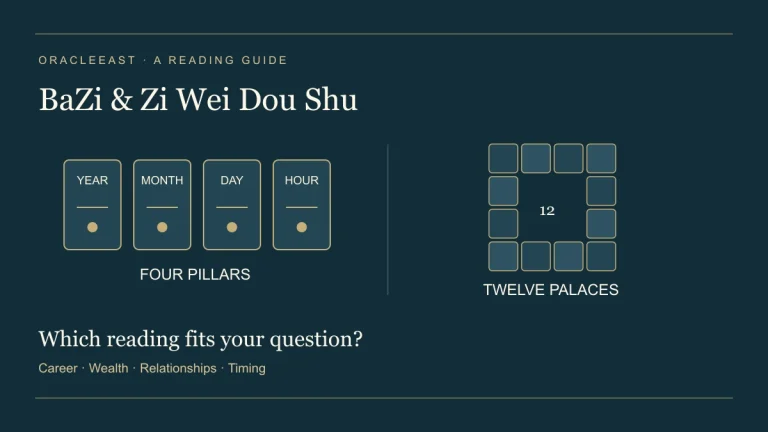


SCHOOL & METHODOLOGY
Ni Hai-Xia’s (倪海厦, 1954–2012) Tian Ji teaching is influential among modern Chinese-speaking students of Zi Wei Dou Shu. This guide explains the working method Oracle East draws from that lineage—and the claims it does not make.
Why a school boundary matters
“Zi Wei Dou Shu” is not one perfectly uniform rulebook. Schools can differ on transformation tables, self-transformations, flying-star techniques, derivative palaces, brightness, and the order in which evidence is weighted. A reading that silently combines every attractive rule becomes impossible to audit: when rules disagree, the reader cannot tell which one controlled the conclusion.
Oracle East therefore names its primary boundary: the Ni Hai-Xia Tian Ji approach. Other traditions may be cited for comparison, but they are not blended into a conclusion without disclosure.
The method in seven steps
1. Establish the chart before interpreting it
Calendar conversion, lunar month, birth hour, and charting convention come first. When the time is uncertain, uncertainty must remain visible. A practitioner should not use a guessed hour to produce a precise palace verdict.
2. Begin with the Life and Body Palaces
The Life Palace (命宫) supplies the natal orientation; the Body Palace (身宫) shows where lived effort becomes concentrated. They are not read as personality labels. Their principal stars, supporting structure, opposing palace, and trines define how the baseline can operate.
3. Locate the major anchors
Four stars receive special structural attention in Oracle East’s working notes: Zi Wei and Tai Yang as markers of authority, service, and visibility; Tian Fu and Tai Yin as markers of storage, resources, planning, and accumulation. Their presence does not guarantee status or wealth. Palace, strength, Lu, support, and malefic pressure determine whether the promise is usable.
4. Read San Fang Si Zheng, not a single palace
A palace is interpreted with its opposite and trine relationships (三方四正). The target palace shows the domain; the opposite can show external conditions; the trines reveal the resource network. This is why a single-star keyword is not a professional judgment.
5. Add benefics, malefics, Lu, and movement
Zuo Fu/You Bi, Wen Chang/Wen Qu, Tian Kui/Tian Yue, Lu Cun, and Tian Ma can describe team support, learning, recognition, stored resources, or mobility. Qing Yang/Tuo Luo, Huo Xing/Ling Xing, Di Kong/Di Jie, and Hua Ji can describe pressure, delay, abruptness, vigilance, leakage, or recurring costs. Paired structures and palace relevance matter more than counting “good” and “bad” stars.
6. Separate natal structure from timing
The natal chart describes the vessel. A ten-year limit (大限) describes a long operating environment; annual and shorter layers identify triggers. When all three repeat a theme, the interpretation gains weight. When they conflict, the reader should show the conflict and reduce certainty.
7. Translate symbolism into reality
A useful conclusion names the domain, evidence, alternative reading, timing window, and a fact the client can verify. It does not hide behind poetic language. For example, “Career Palace receives Hua Quan” is incomplete; the real question is whether the period brings formal authority, heavier accountability without title, or a self-directed project—and what other palaces support each possibility.
What this approach does well
- Structure: it forces the practitioner to connect stars, palaces, axes, and timing.
- Decision relevance: symbolic themes can be converted into questions about ownership, resources, relationships, mobility, and risk controls.
- Verification: the reading can state what evidence would strengthen or weaken a conclusion.
- School discipline: conflicting rules are disclosed rather than quietly combined.
What this approach does not establish
- It does not demonstrate physical causation by named “stars”; the stars are symbolic calculation points, not astronomical bodies acting as a scientific mechanism.
- It does not produce medical diagnoses, legal opinions, investment recommendations, or guaranteed events.
- It does not eliminate uncertainty in historical charts or uncertain birth times.
- It does not justify character judgments about living people based on unverified public birth data.
How Oracle East handles sources
We distinguish three levels: (1) the declared primary teaching boundary; (2) internal working notes that summarize and operationalize the teaching; and (3) comparative or academic sources used for historical context. Paraphrases are not presented as verbatim quotations. If a passage cannot be traced, it is treated as a working interpretation rather than attributed as a direct statement.
Start with these guides
- The twelve palaces and six axes
- How the Four Transformations are read
- The Migration Palace
- Zi Wei Dou Shu chart calculator
Sources and editorial basis
- Oracle East, Methodology & School Boundaries.
- Oracle East, Classical References & Editorial Standards.
- National Taiwan University repository, The Construction of Traditional Chinese Horoscope Astrology (historical and sociological context).
- Open Library, Zi Wei Dou Shu bibliography (catalogue reference).
Looking for a disclosed, human-reviewed method?
Oracle East readings show the chart logic, conflicts, timing layers, and real-world verification points. The current service scope and prices remain on the service page.