
ZI WEI DOU SHU FOUNDATIONS
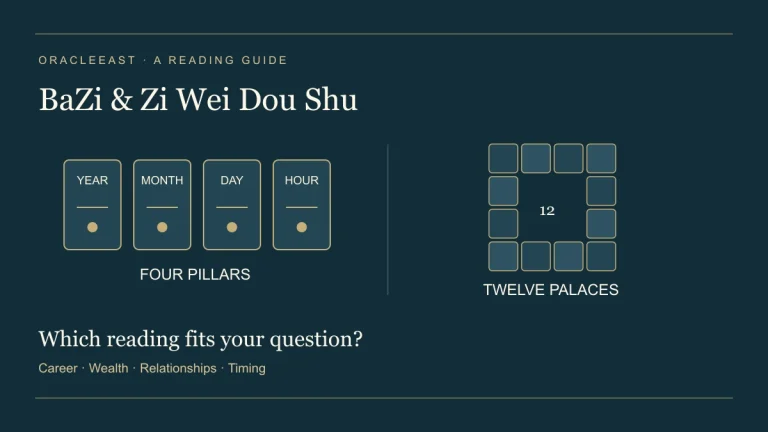
The twelve palaces are not twelve boxes containing fixed outcomes. They form six opposing axes and a network of trines through which identity, resources, relationships, work, movement, and inner life qualify one another.
Before the list: four rules that prevent bad readings
- A palace names the question. It does not answer the question by itself.
- The principal star supplies the operating style. Auxiliary stars, malefics, transformations, and brightness modify it.
- San Fang Si Zheng (三方四正) supplies context. The trine palaces and opposite palace show support, tension, and external conditions.
- Timing activates structure. Natal promise, ten-year limits (大限), and annual layers must be distinguished.
The twelve palaces at a glance
| Palace | Primary question | What it does not prove alone |
|---|---|---|
| Life 命宫 | Baseline temperament, orientation, and the way a person meets life | Fixed personality or lifetime outcome |
| Siblings 兄弟宫 | Siblings, peers, close allies, and same-generation support | The quality of every friendship |
| Spouse 夫妻宫 | Partnership pattern, expectations, and relationship dynamics | A guaranteed marriage event or a partner’s full character |
| Children 子女宫 | Children, juniors, creative extensions, and what one brings forth | Fertility or medical conclusions |
| Wealth 财帛宫 | How resources are pursued, handled, and circulated | Net worth without Career, Fortune, and Property context |
| Health 疾厄宫 | Stress load, vulnerability themes, and bodily attention | A diagnosis, prognosis, or substitute for medical care |
| Migration 迁移宫 | External environment, mobility, relocation, and public-facing conditions | A simple yes/no answer to emigration |
| Friends/Servants 交友宫 | Networks, clients, subordinates, collaborators, and social leverage | Whether one specific person is trustworthy |
| Career 官禄宫 | Working style, responsibility, professional arena, and reputation through work | A single predetermined occupation |
| Property 田宅宫 | Home, property, reserves, family assets, and the ability to retain resources | A guaranteed real-estate gain |
| Fortune 福德宫 | Inner life, satisfaction, values, attention, and subjective wellbeing | A moral score or permanent happiness level |
| Parents 父母宫 | Parents, elders, authority, early guidance, and institutional backing | A complete judgment of either parent |
The six axes
Opposite palaces form a productive tension. Reading these axes is more informative than memorizing isolated palace keywords.
Life–Migration: self and environment
The Life Palace describes the native’s baseline; Migration describes the field outside the familiar environment. A strong external field does not automatically mean “must move abroad.” It can mean that clients, public work, travel, or unfamiliar settings draw out abilities that remain quiet at home.
Siblings–Friends: close allies and wider networks
The Siblings Palace focuses on same-generation closeness and dependable peers; the Friends Palace expands to teams, clients, subordinates, and networks. Together they show whether support is intimate, organizational, transactional, or unstable.
Spouse–Career: partnership and public duty
These palaces often expose trade-offs between intimate expectations and professional structure. They do not mean that career “causes” relationship outcomes; they show where roles, time, authority, and reciprocity need coordination.
Children–Property: what is created and what is retained
Children includes descendants, juniors, and creative output; Property concerns the home base, inherited conditions, and stores of value. This axis asks whether expansion is supported by a stable container.
Wealth–Fortune: money and the experience of enough
The Wealth Palace can be active while the Fortune Palace remains dissatisfied. Income, saving, and subjective ease are different variables. A competent reading separates them.
Health–Parents: capacity and external authority
The Health Palace concerns stress-bearing and vulnerable functions; Parents concerns elders, authority, and institutional support. On sensitive matters, the chart may suggest questions to investigate, never medical facts.
Life Palace, Body Palace, and the timing layers
The Life Palace (命宫) is the natal baseline. The Body Palace (身宫) emphasizes where effort and lived identity become concentrated; depending on its placement, later life may lean more heavily toward career, wealth, partnership, movement, or inner life. Neither should be read without the chart’s star structure.
The natal chart describes enduring tendencies. A ten-year limit describes the stage on which those tendencies are more or less usable. An annual chart identifies shorter triggers. Repetition across the three layers raises confidence; contradiction lowers it and should be disclosed.
How a professional palace analysis is built
- Verify the birth data and charting convention.
- Locate Life and Body Palaces, then the four major anchor stars—Zi Wei, Tian Fu, Tai Yang, and Tai Yin.
- Read the principal star in the target palace, including strength and paired-star structure.
- Trace San Fang Si Zheng: opposite palace, trines, supportive stars, malefics, Lu/Quan/Ke/Ji, Lu Cun, and Tian Ma.
- Compare natal, decade, and annual layers.
- Translate the symbolism into testable real-world questions and note conflicting evidence.
Common errors
- Declaring a palace “empty” and therefore meaningless. An empty palace still has an axis, trines, auxiliary stars, and timing.
- Reducing the Wealth Palace to “rich or poor” or the Spouse Palace to “good or bad marriage.”
- Using one malefic to predict disaster or one benefic to guarantee success.
- Confusing symbolic star names with physical astronomical causation.
- Mixing school rules without stating which rule controls a conflict.
Continue learning
- The Four Transformations in 2026
- How to read the Migration Palace
- Zi Wei Dou Shu chart calculator
- Oracle East methodology
Sources and editorial basis
- Oracle East, Methodology & School Boundaries.
- Oracle East, Classical References & Editorial Standards.
- National Taiwan University repository, The Construction of Traditional Chinese Horoscope Astrology (historical and sociological context).
- Open Library, Zi Wei Dou Shu bibliography (catalogue reference, not a doctrinal authority).
Want the palace network interpreted as a whole?
A Life Map Reading connects the relevant palaces, stars, transformations, decade context, and verification points instead of issuing a one-palace verdict.