
BaZi reference guide · fact-checked 7 August 2026
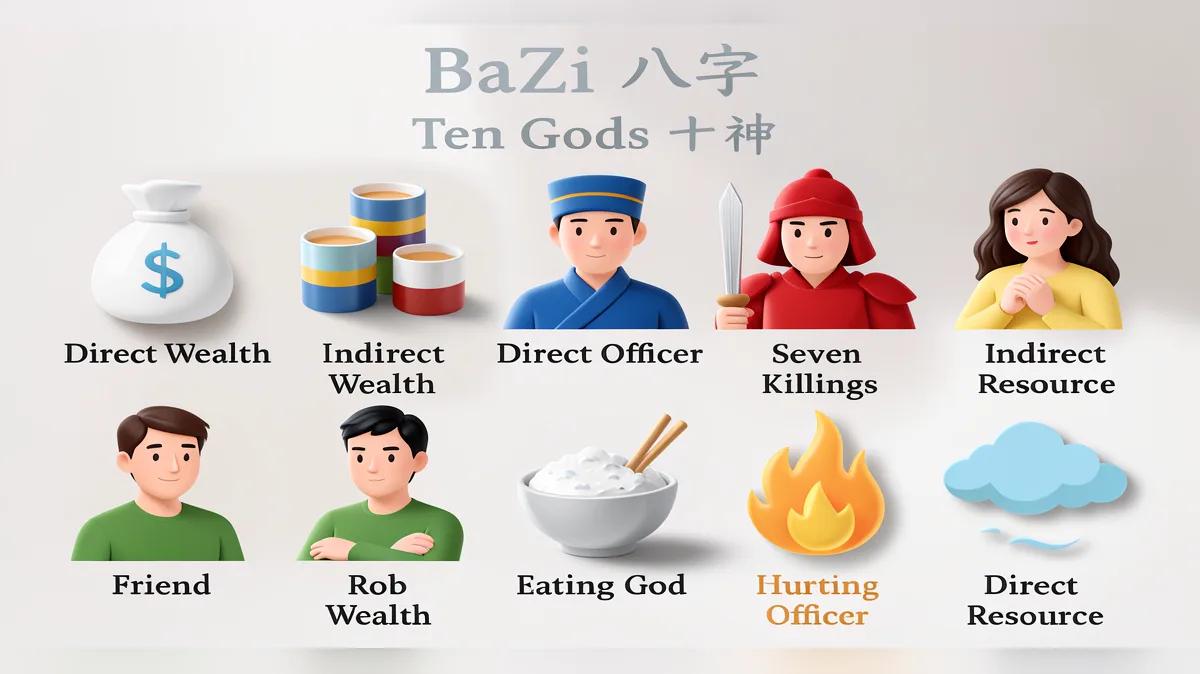
Direct answer: The Ten Gods are ten relationship labels created by comparing every stem in a BaZi chart with the Day Master. Element relationship determines the family—Peer, Output, Wealth, Power, or Resource—while polarity determines the paired name. “Same polarity means Direct” is incorrect: same polarity gives Bi Jian, Shi Shen, Pian Cai, Qi Sha, or Pian Yin; opposite polarity gives Jie Cai, Shang Guan, Zheng Cai, Zheng Guan, or Zheng Yin.
What are the Ten Gods in BaZi?
Your Day Master—the Heavenly Stem of the day pillar—is the reference point. Every other stem is classified by two questions: How does its element relate to the Day Master? Does it have the same or opposite yin–yang polarity? These two comparisons produce ten labels.
| Relationship to Day Master | Same polarity | Opposite polarity | Functional theme |
|---|---|---|---|
| Same element | Bi Jian 比肩 (Friend) | Jie Cai 劫财 (Rob Wealth) | Peers, agency, competition, shared resources |
| Day Master produces it | Shi Shen 食神 (Eating God) | Shang Guan 伤官 (Hurting Officer) | Output, skill, expression, challenge to rules |
| Day Master controls it | Pian Cai 偏财 (Indirect Wealth) | Zheng Cai 正财 (Direct Wealth) | Resources, transactions, stewardship, opportunity |
| It controls the Day Master | Qi Sha 七杀 (Seven Killings) | Zheng Guan 正官 (Direct Officer) | Pressure, authority, responsibility, discipline |
| It produces the Day Master | Pian Yin 偏印 (Indirect Resource) | Zheng Yin 正印 (Direct Resource) | Learning, support, protection, interpretation |
A worked polarity example
For a Yang Wood (Jia 甲) Day Master, another Jia is Bi Jian because element and polarity are the same; Yin Wood (Yi 乙) is Jie Cai because the element is the same but polarity is opposite. Yang Fire (Bing 丙), produced by Jia, is Shi Shen; Yin Fire (Ding 丁) is Shang Guan. Yang Earth (Wu 戊), controlled by Jia, is Pian Cai; Yin Earth (Ji 己) is Zheng Cai. The same comparison logic applies to every Day Master.
How each Ten God should be interpreted
Bi Jian and Jie Cai: peers and agency
Bi Jian often describes self-direction, peers, parallel capacity, and independence. Jie Cai emphasizes competition, alliance, redistribution, and the tension around shared resources. Neither automatically means friendship or loss; chart strength and context decide whether peer energy supplies support or intensifies rivalry.
Shi Shen and Shang Guan: output and expression
Shi Shen tends toward sustained production, craft, teaching, nourishment, and an easier flow of skill. Shang Guan tends toward critique, originality, performance, and resistance to weak authority. Strong output can convert ability into visible work, but excessive output can also drain a weak Day Master.
Pian Cai and Zheng Cai: wealth and stewardship
Pian Cai is associated with broader opportunities, networks, market-facing activity, and less predictable resource flows. Zheng Cai is associated with defined obligations, stable transactions, budgeting, and repeatable stewardship. “Wealth star present” does not equal wealth: the Day Master must be able to manage what it controls, and the wider structure must support realization.
Qi Sha and Zheng Guan: pressure and authority
Qi Sha describes force, competition, urgency, risk, and pressure that demands a response. Zheng Guan describes rules, accountability, position, and legitimate authority. In a coherent structure, pressure can become discipline and responsibility; without support or control, the same symbols can show overload or conflict.
Pian Yin and Zheng Yin: resource and learning
Pian Yin tends toward unconventional learning, pattern recognition, specialist knowledge, and indirect support. Zheng Yin tends toward formal learning, documentation, protection, credentials, and recognized support. Resource can strengthen a weak Day Master, but too much may inhibit output or action.
Why one Ten God cannot be read in isolation
- Season first: month-branch season changes the actual strength of every element.
- Roots and hidden stems: visible stems are only part of the chart.
- Structure: repeated symbols can cooperate, compete, transform, or be constrained.
- Useful and unhelpful functions: the same Ten God can help one chart and burden another.
- Timing: luck pillars and annual influences activate relationships already present or introduce new ones.
Method rule: Oracle East does not turn the Ten Gods into a ten-type personality quiz. The chart is judged as a system: Day Master strength, season, stems, branches, hidden stems, combinations, clashes, and timing must agree before a conclusion is treated as high confidence.
How Ten Gods connect to real questions
Career
Power can describe rules, role and responsibility; Output can describe produced value and public expression; Resource can describe study and support; Wealth can describe assets, customers and transactions; Peer can describe collaboration and competition. The decision comes from how these functions interact, not from selecting one “career star.”
Money
Wealth symbols show what the Day Master controls, but financial outcomes also depend on capacity, support, leakage, competition and timing. A strong Wealth signal can describe responsibility for resources as readily as personal profit.
Relationships
Traditional relationship conventions can use Wealth or Officer symbols in gendered ways, but a responsible reading also examines spouse palace, combinations, clashes, emotional expression, peer dynamics, timing and the client’s real context. One symbol is not a diagnosis of a relationship.
Common Ten Gods mistakes
- Using the incorrect shortcut “same polarity = Direct, opposite = Indirect.”
- Treating every Pian 偏 label as bad or every Zheng 正 label as good.
- Calling a Ten God dominant without checking season, roots and hidden stems.
- Predicting an event from natal presence without a matching timing trigger.
- Reading Wealth, Officer or Resource as a literal outcome instead of a relationship function.
- Ignoring conflicting evidence that lowers confidence.
Frequently asked questions
Which Ten God is most important?
There is no universal winner. Importance depends on the chart’s structure, strength, useful functions and the question being asked.
Do Ten Gods change over time?
The natal chart does not change, but luck pillars and annual or monthly stems and branches can introduce or activate different Ten God relationships.
Are Direct stars better than Indirect stars?
No. Zheng and Pian identify polarity relationships, not a moral score. Either can be constructive or difficult depending on the complete structure.
Can I calculate Ten Gods without an accurate birth time?
The Day Master and six characters from year, month and day can still be calculated, but the hour pillar and some conclusions remain uncertain. Oracle East records that uncertainty instead of inventing precision.
Author, review and sources
Editorial contact: Joy Hu, lead practitioner at Oracle East. Oracle East paid readings are manually analyzed, written and reviewed by a practitioner; software may assist chart calculation or administration, but the paid report is not an automatically generated AI report.
Editorial basis: Zi Ping BaZi’s Day Master relationship model; Oracle East’s Methodology & School Boundaries; and the site’s Classical References & Editorial Standards. See also Brand Facts for practitioner and service verification.
Apply the framework to your own chart
Start with the free BaZi chart. If you want a practitioner to weigh structure, conflicting evidence and timing together, review the current options on the Services page.