
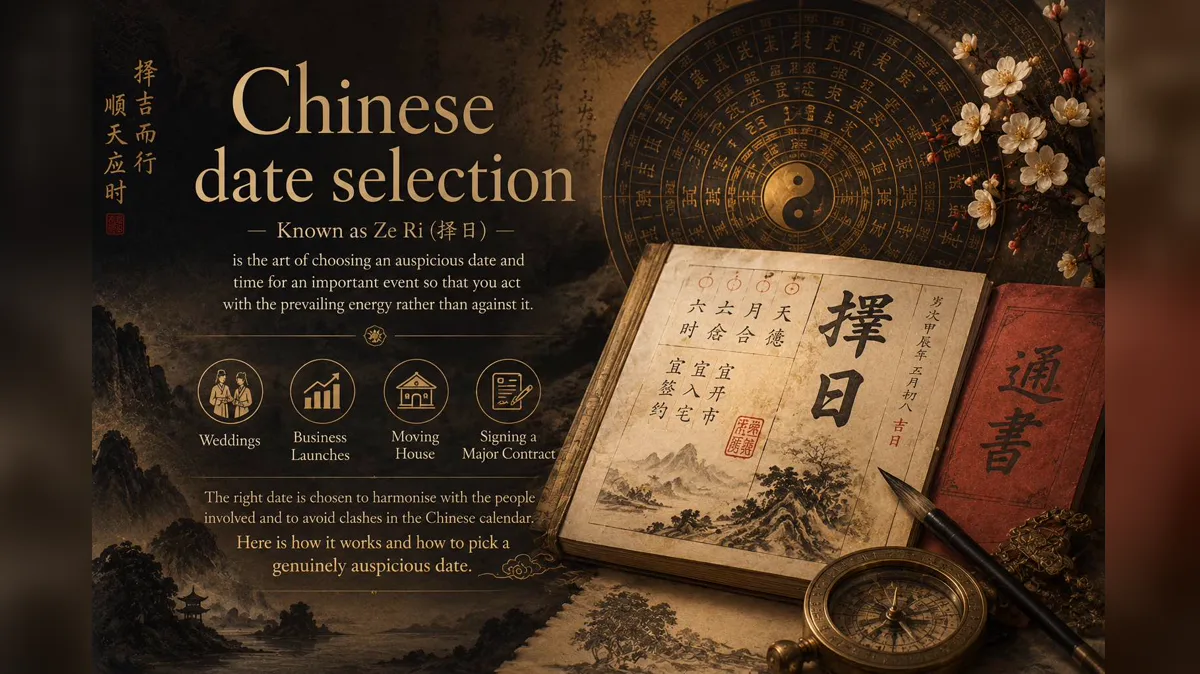

Chinese date selection — known as Ze Ri (择日) — is the art of choosing an auspicious date and time for an important event so that you act with the prevailing energy rather than against it. For weddings, business launches, moving house, or signing a major contract, the right date is chosen to harmonise with the people involved and to avoid clashes in the Chinese calendar. Here is how it works and how to pick a genuinely auspicious date.
What is Ze Ri (date selection)?
Ze Ri is a classical branch of Chinese metaphysics focused purely on timing. Where BaZi reads your life map, date selection answers a narrower question: of the available dates, which one best supports this specific event for these specific people? It treats time as having quality, not just quantity — some windows are open, others are better left alone.
Why does the date matter?
In Chinese thought, every day carries its own elemental character from the stem-and-branch calendar. A date that clashes with the key person’s chart, or with the year’s Tai Sui, can add friction to an already significant moment; a date that supports them adds a tailwind. Choosing well will not guarantee an outcome, but it removes avoidable headwinds and sets a confident, intentional tone — which is why couples and business owners have used Ze Ri for centuries.
How an auspicious date is actually chosen
A proper selection is personalised, not pulled from a generic “good days” list. A practitioner weighs several layers:
- The key person’s BaZi: the date should support the bride and groom (or the business owner), and avoid clashing with their Day Master and animal sign.
- Clashes with the year: dates that clash, harm, or punish the year’s Tai Sui are avoided.
- The day’s stem and branch: the elements of the day itself should favour the event’s purpose — partnership for a wedding, wealth and growth for a business.
- The almanac (Tong Shu 通書): the traditional almanac flags each day’s suitable and unsuitable activities and the “day officers” (Jian Chu) cycle.
- The hour: within the chosen day, a supportive two-hour window is selected for the key moment (vows, ribbon-cutting, signing).
For high-stakes timing, masters may cross-check with strategic systems such as Qi Men Dun Jia or Da Liu Ren to confirm the window.
When people use date selection
- Weddings & engagements — the most common use, harmonising both partners’ charts.
- Business openings & launches — choosing a wealth- and growth-supportive day.
- Signing contracts or closing deals — aligning a decisive moment with favourable energy.
- Moving home or starting renovations — a settled, supportive start.
- Other milestones — important beginnings where you want momentum on your side.
The almanac vs. a personalised selection
You can open a Chinese almanac and find days marked “good for marriage.” The catch: those ratings are general. A day that is broadly auspicious can still clash with your personal chart. True Ze Ri starts from your BaZi and filters the calendar down to the dates that support you specifically — which is why a personalised selection is worth far more than a generic almanac date for a once-in-a-lifetime event.
Choose your date with confidence
Start by knowing your own chart — generate your free BaZi chart so any date can be checked against it. When the moment matters, our Decision Timing and Auspicious Enhancement services select a personalised date and hour for your wedding, launch, or move — harmonised to everyone involved and clear of calendar clashes.
Frequently asked questions
What is Ze Ri or Chinese date selection?
Ze Ri is the Chinese practice of choosing an auspicious date and time for an important event — such as a wedding or business opening — so that the timing harmonises with the people involved and avoids clashes in the Chinese stem-and-branch calendar.
How do I pick an auspicious wedding date?
A good wedding date supports both partners’ BaZi charts, avoids clashing with their animal signs and the year’s Tai Sui, falls on a day whose elements favour partnership, and is confirmed by the almanac. A supportive two-hour window is then chosen for the ceremony itself.
Can I just use a Chinese almanac?
An almanac gives general “good day” ratings, but they are not personalised. A day that looks broadly auspicious can still clash with your own chart, so a tailored selection based on your BaZi is more reliable for major events.
Does the time of day matter too?
Yes. After choosing the date, a favourable two-hour window (the Chinese “hour”) is selected for the key moment — exchanging vows, opening doors, or signing — to align it with supportive energy.
Disclaimer: Date selection is offered for guidance and entertainment. It is not a substitute for professional medical, legal, or financial advice.
Related: Decision Timing · Qi Men Dun Jia · What Is a BaZi Reading?
Sources and editorial basis
- Oracle East, Methodology & School Boundaries.
- Oracle East, Classical References & Editorial Standards.
- Chinese Text Project, Chinese philosophical texts (classical terminology and historical context; not a validation of predictive claims).
Technical terms are presented within the school boundary stated in the article. Comparative references provide context and are not treated as proof of predictive accuracy.