
BaZi Astrology: The Complete Life Map Reading of Your Four Pillars of Destiny
BaZi astrology, also called the Four Pillars of Destiny, arranges birth data into four stem-branch pairs. A reading relates the Day Master to season, roots, Ten Gods and timing cycles. The sections below explain those traditional concepts and the checks needed before applying them to an individual.
Definition — BaZi (八字): literally “eight characters.” The four pairs of Heavenly Stems (天干) and Earthly Branches (地支) generated from your year, month, day, and hour of birth. Systematized by Xu Ziping (徐子平) in the late Tang / early Song dynasty, making the Day Master (日主) the reading anchor — the architectural shift that defines modern BaZi.
1. What BaZi Astrology Actually Is (and Isn’t)
BaZi astrology is best described as a structural diagnostic system built on the Chinese cosmological model of Yin-Yang and Five Phases (阴阳五行). Your eight characters encode the energetic configuration present at the moment you took your first breath.
What BaZi astrology is:
- A traditional interpretive framework. Verified inputs and a stated calendar convention make the chart reproducible; they do not create a measured probability model for life events.
- A timing system — practitioners associate different cycles with life themes. This article provides no statistical model or measured event probabilities.
- A symbolic model of generating and controlling relationships among the Five Phases.
What BaZi astrology is not:
- A horoscope based on constellations. BaZi has no zodiac signs in the Western sense.
- A fatalistic prediction tool. Classical texts explicitly state that human action modifies outcomes.
- A psychology test. Personality is a side product, not the goal.
Luck Pillars and annual pillars are traditional timing layers. Interpret them in relation to the natal structure; this page does not establish their predictive accuracy.
2. The Four Pillars: Year, Month, Day, Hour
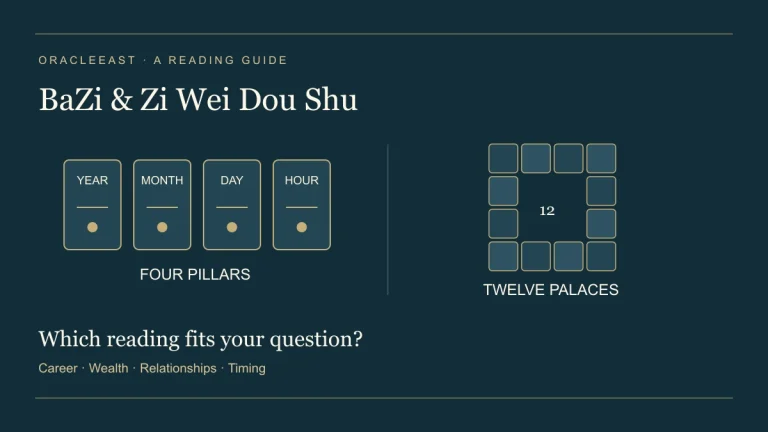
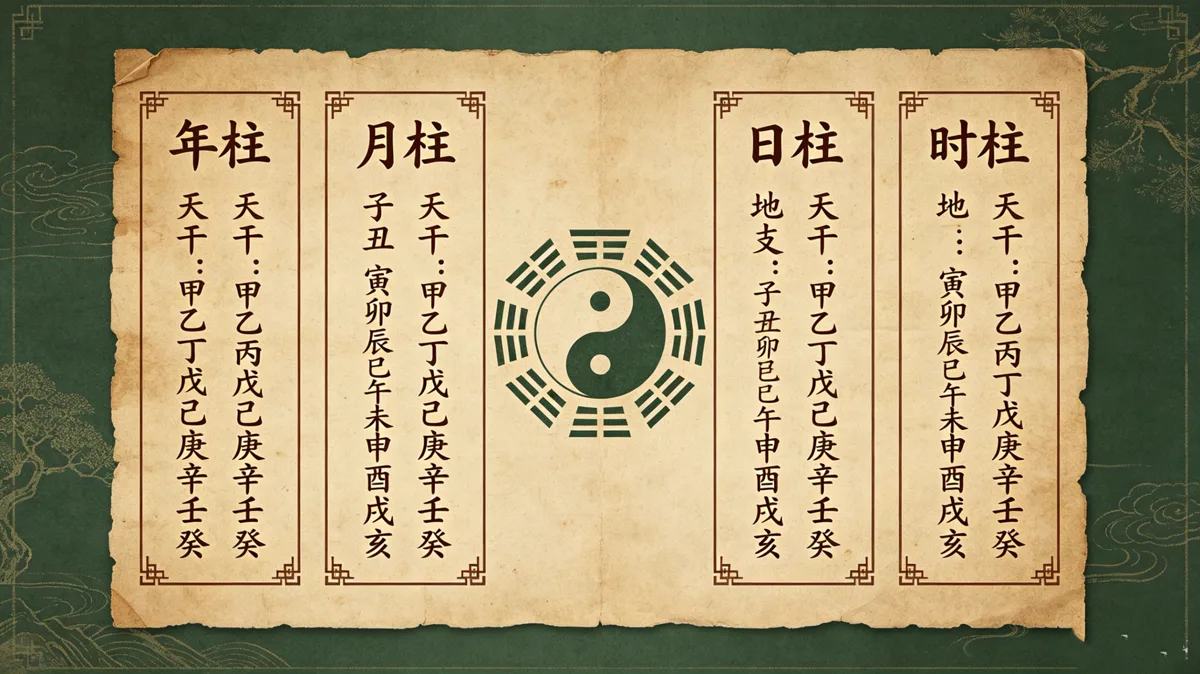
The “four pillars” (四柱) are the four columns of your chart, each containing one Heavenly Stem on top and one Earthly Branch below. Each pillar represents a different life stage and domain:
- Year Pillar (年柱) — Traditionally associated with ancestry, family roots and the broader environment.
- Month Pillar (月柱) — The seasonal reference, also traditionally associated with parents and the working or social environment.
- Day Pillar (日柱) — The Day Stem is the Day Master; the Day Branch is traditionally called the spouse palace.
- Hour Pillar (时柱) — Traditionally associated with children, later life and legacy. These associations do not set fixed age boundaries.
Two layers are present in each pillar. The Heavenly Stem (天干) is the visible “above ground” expression. The Earthly Branch (地支) is the “below ground” stored energy, each branch hiding 1–3 stems inside (藏干). This stem-branch architecture is what makes BaZi structurally different from any Western system.
3. The Day Master: The Anchor of the Entire Reading
The Day Master is you. Everything else in the chart is read in relationship to it. There are 10 possible Day Masters:
- 甲 Jiǎ — Yang Wood: The tall tree — upright, growth-oriented, long-term thinker.
- 乙 Yǐ — Yin Wood: The vine — adaptive, persistent, flexible under pressure.
- 丙 Bǐng — Yang Fire: The sun — radiant, expressive, naturally draws attention.
- 丁 Dīng — Yin Fire: The candle — focused, illuminating, detail-oriented warmth.
- 戊 Wù — Yang Earth: The mountain — stable, conservative, dependable anchor.
- 己 Jǐ — Yin Earth: The field — nurturing, cultivating, quietly supportive.
- 庚 Gēng — Yang Metal: The sword — decisive, reform-oriented, cuts through complexity.
- 辛 Xīn — Yin Metal: The jewel — refined, sensitive, high standards.
- 壬 Rén — Yang Water: The ocean — flowing, far-reaching, strategic thinker.
- 癸 Guǐ — Yin Water: The dew — quiet, infiltrating, deeply perceptive.
Knowing your Day Master is only step one. The real question is whether your Day Master is strong or weak in the context of the whole chart — because that determines what the chart needs.
4. The Ten Gods (十神): Career, Money and Relationships
The Ten Gods (十神) are the ten possible relationships any other stem can have with your Day Master. The same element can mean career, money, or spouse depending on whether it produces, controls, or is controlled by your Day Master.
- 比肩 Bǐjiān / 劫财 Jiécái (Same element): Peers, siblings, competitors. Confidence and independence energy.
- 食神 Shíshén / 伤官 Shāngguān (You produce): Output, creativity, expression, children. How you generate and perform.
- 偏财 Piāncái / 正财 Zhèngcái (You control): Indirect and Direct Wealth are distinguished by polarity relative to the Day Master. They are not equivalent to a guaranteed windfall or salary.
- 七杀 Qīshā / 正官 Zhèngguān (Controls you): Authority, career structure, discipline. Represents the husband for women.
- 偏印 Piānyìn / 正印 Zhèngyìn (Produces you): Mentors, learning, protection, mother energy. Your support system.
5. Useful God (用神): The Concept Beginners Miss
The Useful God (用神) is the element your chart most needs to bring the system into balance. Modern practitioners consider Useful God identification the single skill that separates a hobbyist from a working practitioner.
- Strength-balancing Useful God (扶抑用神): If the Day Master is weak, the Useful God supports it. If strong, the Useful God drains it back toward balance.
- Climate-regulating Useful God (调候用神): Charts born in extreme cold or heat need a warming or cooling element regardless of strength. The canonical source is Qiong Tong Bao Jian (《穷通宝鉴》).
- Pattern-based Useful God (格局用神): The chart forms a recognizable pattern and the Useful God is whatever that pattern requires to complete it.
Why this matters: your Useful God determines which luck pillars are good for you. A career luck pillar can either fuel you or burn you out — entirely depending on whether it brings your Useful God in or attacks it.
6. Luck Pillars (大运) and Annual Pillars (流年): The Timing Engine
If the natal Four Pillars tell you who you are, the Luck Pillars (大运) tell you when the chapters of your life shift. A Luck Pillar lasts 10 years. The Annual Pillar (流年) is the stem-branch of any given year — 2026 is Bǐngwǔ (丙午), pure Yang Fire. The practical rule: the natal chart is the ship, the Luck Pillar is the weather, the Annual Pillar is the day’s wind.
The key interaction types between pillars:
- 合 Hé (combination): Energies merging — alliance, marriage, deals, but also entanglement.
- 冲 Chōng (clash): Direct opposition — movement, change, departure, sometimes accidents.
- 刑 Xíng (penalty): Friction over time — legal issues, chronic conflict.
- 害 Hài (harm): Hidden damage — betrayal, gossip, undermining.
- 破 Pò (breaking): Things falling apart and reforming into something new.
7. Reading the Four Life Domains
7.1 Career
- Direct Officer (正官) dominant: Suited to structured organizations — government, corporate ladder, law, traditional finance.
- Seven Killings (七杀) dominant: Suited to high-pressure competitive arenas — entrepreneurship, athletics, surgery.
- Hurting Officer (伤官) dominant: Creative, unconventional careers — classical warning to avoid pure bureaucratic roles.
- Strong Output with wealth: Knowledge-to-money professions — consulting, content, design, teaching.
7.2 Love and Marriage
Love is read through three lenses: the Spouse Palace (日支) — your innate marriage tendencies; the Spouse Star — Officer elements for women, Wealth elements for men; and the timing of combinations and clashes to the Day Pillar across Luck and Annual Pillars, which reveals windows for meeting, marrying, or separating.
7.3 Health boundaries
Traditional element-to-organ correspondences are not a medical assessment. A BaZi chart cannot establish a diagnosis, disease risk or treatment need. Health questions require clinical evidence and a qualified clinician.
7.4 Wealth
Wealth in BaZi requires three things: a wealth element present and rooted, a Day Master strong enough to carry it, and a favorable Luck Pillar that activates it at a productive life stage. As San Ming Tong Hui states: “身弱财多,富屋贫人” — “weak self with abundant wealth makes a poor person in a rich house.”
8. BaZi Astrology vs Western Astrology
- Time basis: Western uses the sky at birth; BaZi uses the solar calendar converted into stem-branch cycles.
- Birth location: BaZi calculation uses the birth date and time together with the country and city to check historical time zone, daylight saving and true solar time. A street address is unnecessary.
- Core symbols: Western uses 12 signs, 10 planets, 12 houses; BaZi uses 10 stems, 12 branches, 5 elements, Ten Gods.
- Primary lens: Western focuses on personality; BaZi focuses on structural balance and life-stage timing.
- Timing system: Western uses transits and progressions; BaZi uses 10-year Luck Pillars and Annual Pillars.
The single most useful insight: a Western chart asks “who are you?”; a BaZi chart asks “what is your system, and what does it need next?”
9. BaZi Astrology vs Zi Wei Dou Shu
- Core unit: BaZi uses 8 characters; Zi Wei uses 12 palaces and 100+ stars.
- Strength: BaZi excels at macro structure and timing; Zi Wei excels at granular life-domain detail.
- Reading style: BaZi is engineering and structural; Zi Wei is narrative and star-based.
- Best for: BaZi for big-picture life map and timing; Zi Wei for detailed situational analysis.
A practical rule: use BaZi for the big map and timing engine; use Zi Wei for the high-resolution close-up of a specific life domain.
10. How to Start Reading Your Own Chart in 7 Steps
- Generate the chart using a reputable BaZi calculator.
- Identify your Day Master — the upper character of the Day Pillar.
- Evaluate strength — count root support in the branches and season of birth.
- Assess useful factors — compare the month-order structure, seasonal strength and climate needs. Explain conflicts between these lenses instead of applying a fixed shortcut.
- Map the Ten Gods — name every other stem by its relationship to the Day Master.
- Walk the Luck Pillars — note which decades bring the Useful God in or attack it.
- Overlay the current Annual Pillar — your weather report for the year.
11. Common Misconceptions About BaZi Astrology
- “BaZi is just Chinese zodiac.” No. The 12 animals are only the year branch — one of eight characters.
- “A bad chart means a bad life.” Classical doctrine explicitly rejects this. Timing and human action reshape outcomes.
- How exact must the birth time be? Give the recorded time if known, or an approximate range. Minutes can matter near an hour, day or solar-term boundary after time correction.
- “All BaZi software gives the same result.” No — software differs in solar term boundaries and time corrections.
- Does the chart establish every event? No. An interpretation needs a complete reasoning chain; this article does not establish measured event probabilities.
FAQ
Q: What is the difference between BaZi astrology and Four Pillars of Destiny?
They are the same system. “BaZi” (八字) is the Chinese term; “Four Pillars of Destiny” is the most common English translation.
Q: Do I need my exact birth time?
Give the recorded birth time if available; otherwise provide an approximate range or say it is unknown. Country and city are used to check historical time zone and true solar time. Near a boundary, compare candidate pillars. The Day Branch is not lost solely because the birth hour is unknown, but hour-dependent conclusions remain uncertain.
Q: Is BaZi religious?
No. It is a cosmological and philosophical system rooted in Yin-Yang and Five Phases theory. You can use BaZi while practicing any faith or none.
Q: How is BaZi different from Feng Shui?
BaZi reads time-based energy — your birth moment and life cycles. Feng Shui reads space-based energy — your environment. Many practitioners use both together.
Q: Can BaZi predict my marriage year?
It can identify windows — Luck Pillar and Annual Pillar combinations that historically correlate with marriage events. It cannot predict an exact wedding date.
Disclaimer
⚠️ This article is for educational and self-reflection purposes only. It is not a substitute for medical, legal, or financial advice. BaZi astrology readings identify tendencies and timing windows, not certainties.